
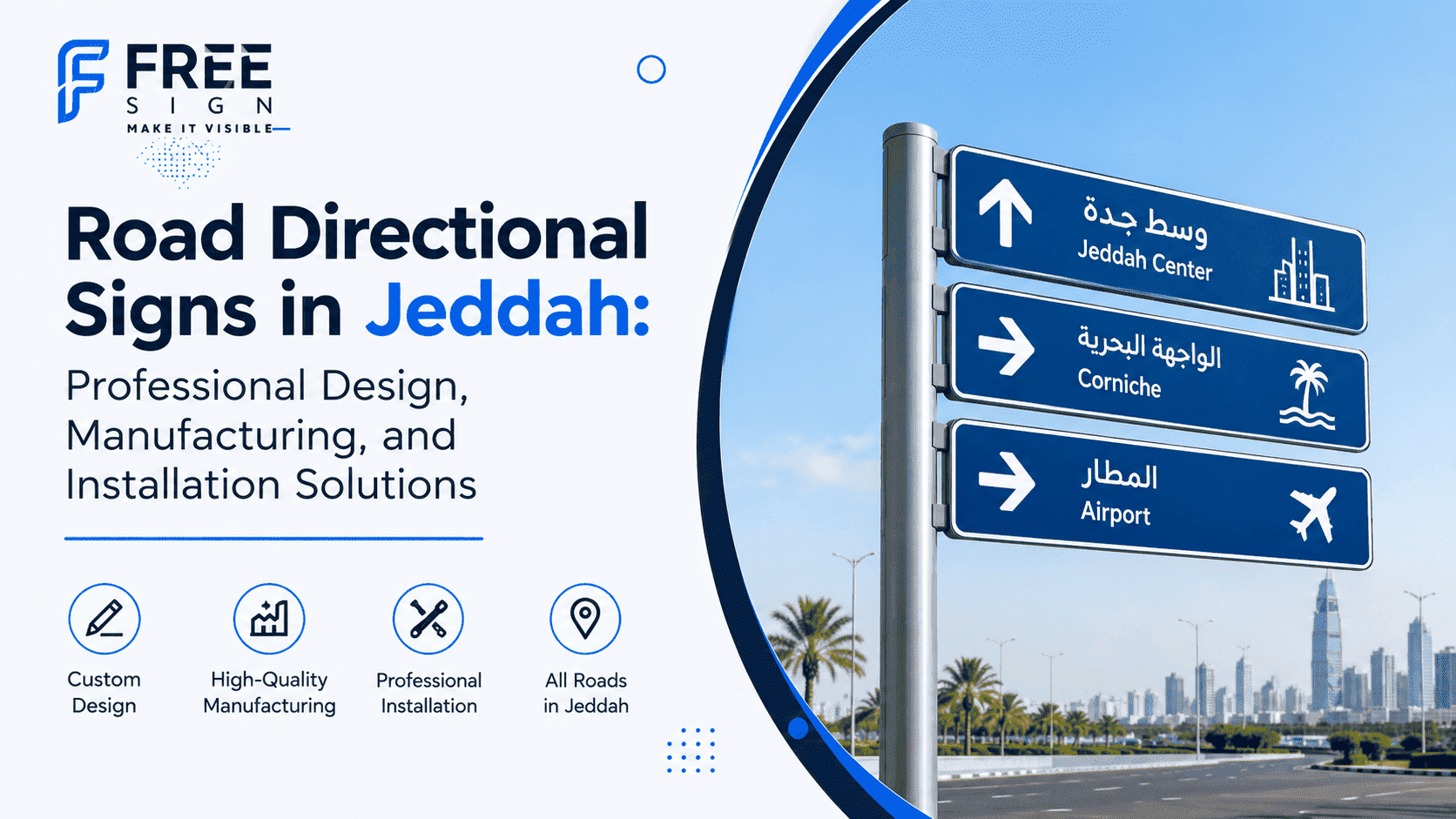
Road directional signs are among the most essential elements contributing to traffic management and ensuring the safety of pedestrians and drivers alike. They are not merely fixed metal or plastic signs; they represent a standardized visual language that translates traffic rules into clear symbols understood by everyone, regardless of language or cultural background.
In Saudi Arabia, where road infrastructure continues to develop in line with the ambitious Vision 2030, the need for high-quality, durable directional signs capable of withstanding harsh climatic conditions has become more important than ever. Whether you are responsible for a major construction project, manage a commercial facility, or work in the municipal sector, choosing the right partner for manufacturing and installing directional signage is a strategic decision that directly impacts public safety and transportation efficiency.
The Importance of Road Directional Signs in Saudi Arabia’s Infrastructure
Road directional signs are an essential part of urban and intercity transportation systems. They provide drivers with the information they need to make the right decisions at the right time, such as directions to major destinations, warnings about potential hazards, and information about services available along the road. In Saudi Arabia, where the road network stretches across thousands of kilometers and connects major cities such as Riyadh, Jeddah, Dammam, Makkah, and Madinah, traffic signs play a vital role in managing traffic flow and enhancing road safety.The Role of Directional Signs in Traffic Management
Directional signs help drivers identify routes and destinations, contributing to reduced congestion and smoother traffic flow, particularly in urban areas and on highways.The Importance of Directional Signs in Enhancing Road Safety
Directional and warning signs alert drivers to potential hazards and give them sufficient time to prepare and adapt to road conditions.Directional Signs as Part of a City’s Visual Identity
The importance of directional signs goes beyond geographic navigation. They are also an integral part of the visual identity of modern cities, reflecting the level of urban organization and attention given to the experience of residents and visitors.Factors Affecting Directional Sign Design
Designing directional signs requires a careful assessment of the location, traffic patterns, expected speeds, and environmental factors to ensure long-term visibility and effectiveness.Read Also: Modern Commercial Storefront Design
Types and Classifications of Road Directional Signs
Road directional signs can be divided into several main categories, each serving a specific purpose and having its own design requirements. Understanding these classifications helps ensure that signs are properly distributed throughout the road network.Informational Directional Signs
Informational signs provide drivers with general information that makes navigation easier, such as street names, neighborhoods, industrial areas, airports, hospitals, and shopping centers.Warning and Hazard Signs
Warning signs alert drivers to potential hazards on the road, such as sharp curves, dangerous intersections, school crossings, and roadwork areas.Mandatory and Regulatory Signs
Mandatory signs require drivers to follow specific instructions, such as traveling in a designated direction or using a particular lane. Regulatory signs, meanwhile, specify traffic restrictions such as maximum speed limits, no parking, and no entry.Emergency and Evacuation Signs
Emergency and evacuation signs are used in tunnels, bridges, highways, and public facilities to guide drivers and pedestrians toward emergency exits, first-aid points, and fire stations.Facility and Building Signs
Facility and building signs are used in shopping complexes, hospitals, universities, hotels, and administrative offices to help visitors identify their locations and reach their destinations easily.Indoor Directional Signs
These include floor number signs, elevator and staircase directions, and restroom signs.Outdoor Directional Signs
These include main and secondary entrance signs, parking signs, and signs identifying areas designated for people with disabilities.Learn More: Commercial Store Signage Design and Installation in Jeddah
Quality Standards and Technical Specifications for Road Directional Signs
Road directional signs cannot be discussed without addressing the technical standards governing their manufacturing and installation. The quality of materials and design directly affects sign visibility, durability, and service life.Materials Used to Manufacture Directional Signs
High-quality signs are typically manufactured from corrosion-resistant aluminum, a lightweight metal capable of withstanding harsh weather conditions. In certain specialized applications, materials such as galvanized steel, reinforced plastic, or compact panels may be used, particularly for indoor applications.Reflective Sheeting and Its Importance
Reflective film is one of the most important components determining the quality of traffic signs, as it improves visibility at night and under low-light conditions.Reflectivity Grades Used in Traffic Signs
Several reflectivity grades are available, ranging from Engineer Grade to High Intensity and Diamond Grade.Choosing the Appropriate Reflectivity Grade
The higher the reflectivity grade, the higher the cost of the sign. However, higher-grade reflective materials provide clearer visibility over greater distances, particularly on highways and in areas with heavy nighttime traffic.Printing and Protective Coating
Signs should be printed using inks resistant to fading and peeling, followed by the application of a transparent protective coating to protect the surface from scratches and weather exposure.Sign Support Structures
Poles and foundations must be designed to withstand high wind speeds, vibrations caused by traffic movement, and potential impacts.Protecting Metal Structures from Rust
Galvanized steel pipes are commonly used with epoxy or polyester coatings to protect them against corrosion.Protecting Signs in Coastal Areas
In coastal areas such as Jeddah and Dammam, applying an additional salt-resistant coating is recommended to extend the service life of the structure.Learn More: Best Advertising Company in Jeddah
Environmental and Climatic Factors in Saudi Arabia
Saudi Arabia is one of the most challenging environments for installing road directional signs due to its diverse climate and harsh weather conditions. Manufacturers and suppliers must take these factors into account when selecting materials and designs:High Temperatures
In the inland desert and central regions, temperatures rise significantly during the summer, causing metal materials to expand and placing stress on adhesive layers and reflective sheeting. Outdoor directional signs used in these areas require materials with a low coefficient of expansion and the ability to return to their original shape after cooling.Dust and Sandstorms
The northern and eastern regions are frequently exposed to sandstorms that reduce visibility and can cause surface scratches on signs. Therefore, it is preferable to use thick protective films and smooth surfaces that reduce sand adhesion and make cleaning easier.Humidity and Salinity
Along the western and eastern coasts, high humidity and salinity are among the main factors contributing to corrosion. Directional signs used in Jeddah, Yanbu, Dammam, and Khobar require special surface treatments and resistance to chemical corrosion.High Solar Radiation
Continuous exposure to ultraviolet (UV) radiation can cause colors to fade and protective films to peel. Directional signs used in Saudi Arabia require UV-resistant inks and reflective materials to maintain their appearance and color for many years.Applications of Directional Signs Across Different Sectors
The benefits of road directional signs are not limited to public roads. They extend to a wide range of sectors and industries throughout the Kingdom:Government and Municipal Sector
Traffic signs are used in major government projects, including urban road development, bridge and tunnel construction, and traffic management around public facilities. Directional signs play a key role in Vision 2030 projects related to infrastructure and public transportation.Commercial and Retail Sector
In shopping malls, retail centers, and markets, indoor directional signs help visitors locate stores, restrooms, elevators, and emergency areas. They contribute to improving the customer experience and reducing congestion in corridors.Healthcare Sector
Hospitals and healthcare centers require clear and accurate building directional signs to guide patients and visitors toward clinics, emergency rooms, pharmacies, and administrative departments. These signs should comply with accessibility standards for people with disabilities.Education Sector
Universities and schools use wayfinding signs to facilitate navigation across large campuses and identify academic buildings, libraries, cafeterias, and bus stops.Industrial Sector
In factories and industrial facilities, emergency directional signs play a vital role in guiding workers toward emergency exits, firefighting stations, and safe areas during accidents. Safety signs are also used to identify hazardous areas and personal protective equipment requirements.Tourism and Hospitality Sector
With the rapid growth of the tourism sector in Saudi Arabia, indoor and outdoor directional signs have become essential in hotels and resorts to guide guests toward restaurants, swimming pools, gyms, and reception areas.Design and Manufacturing Process
Road directional signs go through several precise stages, from initial design to final installation. Each stage requires technical expertise and the use of advanced technologies:Site Assessment and Field Survey
Before starting the design process, an accurate field survey should be conducted to determine the best locations for installing directional signs, measure viewing distances, identify viewing angles, and assess the surrounding environmental conditions. This assessment helps determine the appropriate sign sizes and optimal locations to ensure maximum effectiveness.Engineering Design
Design is a critical stage that requires coordination between traffic engineers, graphic designers, and safety experts. The design must take into account visibility, reading speed, color contrast, and compatibility with the site’s visual identity. Specialized CAD software is used to create 3D models that help evaluate the final appearance before manufacturing.Manufacturing and Production
Directional signs are manufactured in specialized workshops equipped with advanced machinery. The process includes cutting, bending, welding, printing, and protective coating. Professional manufacturers focus on quality control at every stage to ensure that the final product is free from defects that could affect its performance.Installation and Maintenance
Installing directional signs requires a specialized team with experience in civil and electrical works, particularly in the case of illuminated directional signs, which require safe and waterproof electrical connections. After installation, regular inspections should be carried out to ensure the structural integrity, sign visibility, and proper operation of lighting systems, if applicable.Modern Trends in the Signage Industry
The road directional signage industry has undergone significant developments in recent years, driven by technological advancements and changing market needs:Smart and Digital Signs
Digital directional signs have begun to appear in some major Saudi cities. These signs consist of LED or LCD screens whose content can be updated remotely. This technology can be used to change messages based on the time of day, traffic conditions, or special events, providing unprecedented flexibility.Sustainable Materials
With growing environmental awareness, some companies have started using recycled or recyclable materials in directional sign manufacturing, along with environmentally friendly printing technologies that reduce harmful emissions.Integration with Navigation Systems
Some modern wayfinding signs are designed to incorporate QR codes or NFC technology, allowing users to scan the sign with their smartphones to access additional information or receive accurate directions through navigation applications.Energy-Efficient Lighting
For illuminated directional signs, LED technology has become the new standard instead of traditional lighting. LED systems consume up to 80% less energy while offering a significantly longer lifespan.Why Choose Free Sign for Directional Signage Solutions?
When it comes to choosing a reliable partner for manufacturing and installing road directional signs in Saudi Arabia, Free Sign stands out as a solution that combines practical experience, technical quality, and a commitment to safety standards. Over the years, the company has provided comprehensive signage solutions for clients across various sectors, ranging from government projects to commercial and industrial facilities.Comprehensive Solutions from Design to Maintenance
Free Sign provides a comprehensive service covering every stage of the project, starting with the initial assessment and field survey, followed by engineering design and manufacturing, and ending with professional installation and regular maintenance. The engineering team selects materials and technologies based on the nature of each site, helping produce directional signs capable of withstanding the climatic conditions of Saudi Arabia, including:- High temperatures.
- Sandstorms and dust.
- Humidity and salinity in coastal areas.
- Continuous exposure to sunlight.
- Different usage conditions across roads and facilities.
Key Benefits of Working with Free Sign
Quality and Durability
Free Sign is committed to applying quality standards throughout the production process, using materials suitable for outdoor applications, such as corrosion-resistant aluminum and high-quality reflective sheeting. This helps maintain sign visibility and durability for extended periods.Customized Design Based on Project Requirements
The company provides signage solutions designed according to the client’s visual identity, site characteristics, and usage requirements. These solutions include:- Indoor directional signs for offices and facilities.
- Outdoor signs for buildings and complexes.
- Highway signs.
- Parking signs.
- Directional signs for commercial and industrial projects.
Fast Project Execution
Well-equipped manufacturing workshops and specialized teams help execute projects according to a clear schedule while maintaining a balance between fast delivery and the quality of the final product.Competitive and Transparent Pricing
Free Sign provides comprehensive solutions at competitive prices, with a clear breakdown of costs related to design, materials, manufacturing, and installation. This helps clients choose the solution that best suits their budget and requirements.Technical Support and After-Sales Services
The company’s relationship with the client does not end after the signs are installed. Its services also include technical follow-up and regular maintenance to help maintain the signs’ performance, appearance, and visibility throughout their service life.Diverse Signage Services and Solutions
In addition to manufacturing and installing road directional signs, Free Sign provides a wide range of visual identity and advertising solutions, including:- Advertising storefronts.
- 3D letters.
- Stickers and promotional materials.
- Cladding panels.
- Illuminated acrylic signs.
- Customized indoor and outdoor signs.
Compliance with Standards and Specifications
Free Sign is committed to implementing signage according to applicable technical and regulatory requirements, while taking into account relevant road and traffic safety specifications and obtaining the necessary approvals from the competent authorities based on the nature and location of each project.Learn More: Free Sign’s Recent Projects
Conclusion
Road directional signs are an essential element in managing traffic, enhancing safety, and improving the user experience on roads and within various facilities. Whether a project involves infrastructure or commercial and industrial buildings, choosing the right signage company directly affects the quality, lifespan, and visibility of the signs. By combining customized design, high-quality materials, technical expertise, and professional installation and maintenance services, Free Sign provides directional signage solutions that help achieve safety, clarity, and a professional appearance at the same time.Frequently Asked Questions About Road Directional Signs
What Is the Lifespan of Road Directional Signs?
The lifespan depends on the type of materials used, manufacturing quality, surrounding environmental conditions, and level of maintenance. In general, high-quality signs can last between 7 and 15 years when properly used and maintained, although the actual lifespan varies from one project to another.Can the Colors and Designs of Directional Signs Be Customized?
Yes. Signs can be designed according to the site’s visual identity and project requirements, while complying with traffic standards governing the colors, shapes, and symbols used for regulatory and warning signs.What Is the Difference Between Reflective and Illuminated Signs?
Reflective signs rely on reflecting vehicle headlights, which helps make them visible at night. Illuminated signs, on the other hand, contain an independent light source, such as LED lighting, to display text and symbols clearly.How Much Does It Cost to Install Road Directional Signs?
The cost varies depending on several factors, including:- Sign dimensions.
- Type of material used.
- Reflectivity grade.
- Type of supporting structure.
- Installation location.
- Complexity of the installation work.
- Number of signs required.
3 thoughts on “Road Directional Signs in Jeddah: Professional Design, Manufacturing, and Installation Solutions ”