
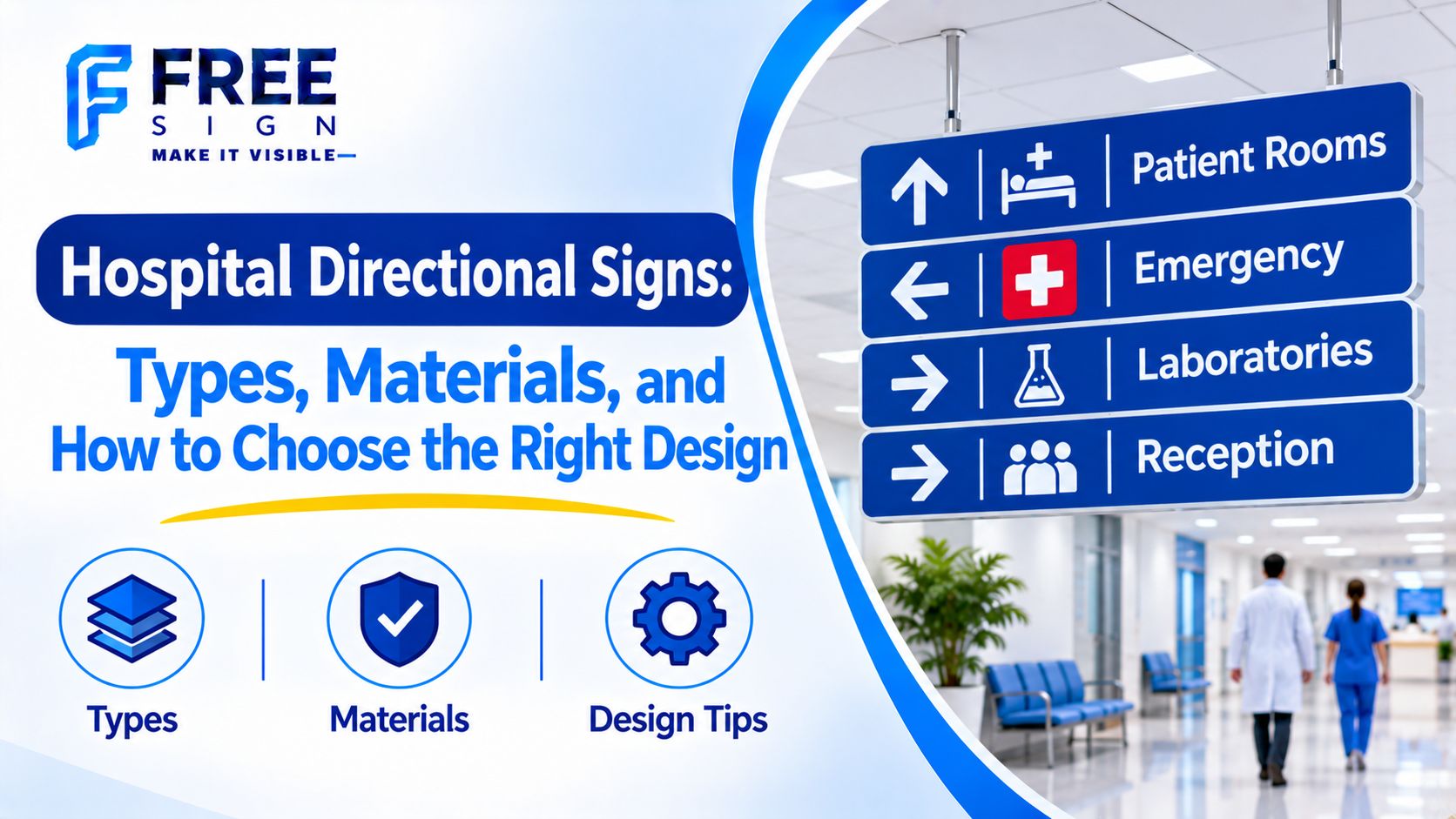
When patients and visitors enter a hospital, they need to find departments, clinics, laboratories, imaging centers, and other services without unnecessary confusion. In large healthcare facilities, unclear directions can make navigation stressful, especially for people visiting for the first time. This is why Hospital Directional Signs are essential. They help organize movement, guide visitors to their destinations, and make healthcare facilities easier to navigate. Choosing the right signs involves more than selecting attractive designs. It requires clear information, suitable materials, strategic placement, and an understanding of how patients and staff use the building.
Why Are Hospital Directional Signs Important?
Hospital Directional Signs help patients, visitors, and employees find their destinations without repeatedly asking for directions. Their importance increases in large healthcare facilities with multiple floors, departments, corridors, and buildings.
A well-planned signage system offers several benefits:
- Easier access to departments: Helps visitors locate outpatient clinics, emergency departments, imaging centers, laboratories, and pharmacies.
- Better visitor movement: Provides directions to entrances, exits, elevators, stairs, and waiting areas.
- Improved safety: Identifies restricted areas, potential hazards, and emergency evacuation routes.
- Less confusion: Provides clear information in an environment that may be unfamiliar or crowded.
- A better patient experience: Makes navigation more convenient and allows visitors to find their destinations independently.
- Consistent visual identity: Creates a more organized appearance through coordinated colors, fonts, symbols, and sign layouts.
Hospital signage should work as one connected wayfinding system. A sign at the main entrance is not enough if visitors cannot follow clear directions through corridors, intersections, and different floors.
Read also: Installing Raised Letters for Commercial Storefronts
What Are the Main Types of Hospital Directional Signs?
Hospitals need different types of signs depending on their layout, services, and visitors’ needs. These signs can be divided into several categories, each serving a specific purpose.
1. Department and Clinic Identification Signs
Department signs identify medical services and help patients recognize the correct destination.
Common examples include:
- Emergency Department
- Outpatient Clinics
- Radiology Department
- Laboratory
- Pharmacy
- Operating Rooms
- Intensive Care Unit
- Pediatrics Department
- Maternity and Obstetrics
- Physical Therapy Department
These signs are usually installed above department entrances or beside doors. Their text should be easy to read, with suitable font sizes and clear contrast between the lettering and background.
2. Internal Directional Signs
Directional signs guide visitors through the hospital and help them reach different departments without taking unnecessary routes.
They may include arrows, department names, floor numbers, and symbols for elevators or staircases.
For example, a visitor entering a hospital may need signs directing them toward outpatient clinics, the laboratory, the pharmacy, or the main reception desk.
In larger facilities, directional signs should be placed at important decision points, such as corridor intersections, elevator areas, entrances, and changes in direction. This allows visitors to identify the correct route before reaching a confusing area.
3. Emergency and Evacuation Signs
Emergency signage is among the most important elements of a healthcare facility. It helps people identify emergency exits, evacuation routes, and assembly points when an emergency occurs.
Examples include:
- Emergency Exit
- Emergency Evacuation Route
- Assembly Point
- Fire Safety Signs
- Fire Extinguisher Identification
- Emergency Exit Direction Signs
These signs must remain visible and easy to understand. Their design, placement, and lighting should comply with the applicable building safety and fire protection requirements.
Emergency signs should never be treated as decorative elements. Their main purpose is to communicate essential safety information quickly.
4. Warning and Safety Signs
Warning signs alert patients, visitors, and employees to potential hazards or instructions that must be followed in specific areas.
Common examples include:
- Radiation Hazard
- No Entry
- Wet Floor
- No Smoking
- Staff Only
- X-Ray Room Warning
- MRI Safety Instructions
The message should be direct and easy to recognize. Appropriate symbols can help communicate warnings without requiring visitors to read lengthy explanations.
The exact warning should match the risks associated with the area. For example, MRI rooms require specific safety information because certain metal objects and equipment may be dangerous in the magnetic environment.
5. Waiting Area and Public Facility Signs
Visitors also need directions to public facilities and support services throughout the hospital.
These signs may identify:
- Waiting Areas
- Restrooms
- Elevators and Staircases
- Prayer Rooms
- Reception and Registration
- Information Desks
- Parking Areas
- Cafeterias and Service Counters, where available
Providing clear directions to these facilities makes the hospital easier to navigate and can reduce the number of routine questions directed to reception staff.
6. Room and Door Identification Signs
Room identification signs explain the purpose of individual rooms or units. Depending on the hospital’s requirements, they may display room numbers, department names, doctors’ names, or service information.
Examples include doctors’ offices, examination rooms, treatment rooms, nursing stations, administrative offices, and meeting rooms.
It is useful to consider future updates when designing these signs. A system that allows names or room numbers to be changed can reduce replacement costs when departments or room functions change.
Learn more: How to Install Cladding Facades
What Makes Hospital Directional Signs Effective?
A hospital sign should do more than look professional. It must communicate information clearly in an environment used by people with different ages, languages, and physical abilities.
Should Hospital Signs Be in Arabic and English?
In Saudi hospitals, providing information in both Arabic and English is an important consideration because patients and visitors may come from different linguistic backgrounds.
However, including two languages should not make the design crowded. Each language needs sufficient space, clear typography, and a logical reading order.
It is also important to review translations of department names and medical services before production. Inconsistent terminology across signs can confuse visitors and make the wayfinding system less effective.
How Should You Choose Colors and Fonts?
Colors and typography influence how quickly visitors understand information. Simple, readable fonts are generally more effective than decorative lettering, especially in signs that need to be read from a distance.
Consider the following design principles:
- Use strong contrast between the text and background.
- Select font sizes appropriate for the viewing distance.
- Keep arrows and symbols consistent throughout the facility.
- Use coordinated colors to distinguish departments or floors.
- Avoid placing too much information on one sign.
A hospital may use different colors to identify departments or building levels. However, visitors should not have to rely on color alone to understand directions. Department names, numbers, and recognizable symbols should remain clearly visible.
Do Hospitals Need Illuminated Signs?
Illuminated signs can be useful in selected locations, including main entrances, emergency exits, and corridors with limited lighting.
However, not every hospital sign needs to be illuminated. The decision depends on the location, lighting conditions, safety requirements, and the type of information being displayed.
Lighting should also be designed carefully to avoid glare or reflections that make the sign difficult to read.
How Can Signage Support People with Disabilities and Older Visitors?
Hospital signage should consider the different needs of its users, including people with visual impairments, mobility limitations, and reading difficulties.
Useful considerations include:
- Choosing clear fonts and appropriate text sizes.
- Providing strong contrast between text and background.
- Installing signs where they can be easily seen.
- Using recognizable and simple symbols.
- Considering raised lettering or Braille where appropriate.
- Avoiding locations where signs may be hidden behind doors, furniture, or other objects.
Accessibility features and installation positions should follow the applicable accessibility standards and requirements for the facility.
Read also: Modern Shopfront Design
What Are the Best Materials for Hospital Signs?
The choice of material affects the sign’s appearance, durability, maintenance requirements, and suitability for different locations. The material should match the installation environment and the expected level of use.
Aluminum Signs
Aluminum is widely used for indoor and outdoor signage because it is lightweight, durable, and suitable for different finishing options.
It can be used for entrance signs, directional signs, department identification, and general information boards. The final finish should be selected according to the location and design requirements.
Acrylic Signs
Acrylic offers a clean and modern appearance and is available in different colors, thicknesses, and finishes.
It is commonly suitable for department names, office signs, reception areas, and indoor corridors. Acrylic can also be combined with lighting in certain designs to create illuminated signs.
Stainless Steel Signs
Stainless steel is a suitable option when a professional appearance and distinctive finish are important.
It can be used for department identification, office signs, and main entrance signage. Its suitability depends on the design, manufacturing method, installation conditions, and maintenance requirements.
Vinyl Stickers and Graphics
Vinyl graphics are useful for applying text, numbers, arrows, and directional information to suitable walls, doors, and other surfaces.
They can be practical when a hospital needs to update information or add signs without installing separate rigid panels. The vinyl type should be selected according to the surface and expected cleaning conditions.
Forex and Other Plastic Materials
Forex and other lightweight plastic materials can be used for indoor signage, particularly when ease of production and lightweight construction are priorities.
However, their durability and fixing methods should be evaluated before using them in areas exposed to frequent contact or demanding conditions.
How Should Hospital Directional Signs Be Planned and Installed?
An effective signage system begins with understanding how people move through the hospital. Selecting materials and designing individual signs should come after reviewing the building layout and visitor routes.
The planning process usually includes the following steps:
1. Review the hospital layout: Identify entrances, exits, floors, corridors, departments, and public facilities.
2. Identify user routes: Understand how patients, visitors, and employees move between different areas.
3. Locate decision points: Identify places where people need to choose a direction, corridor, staircase, or elevator.
4. Classify the signs: Divide the required signs into identification, directional, warning, public facility, and safety categories.
5. Determine installation locations: Choose visible positions that are not blocked by doors, columns, furniture, or decorative elements.
6. Establish a consistent design: Use coordinated colors, fonts, symbols, and layouts throughout the facility.
7. Review the routes: Check whether visitors can follow the directions without encountering missing information or contradictory instructions.
Testing the routes with people who have never visited the hospital can help identify confusing areas before the signage system is finalized.
What Factors Affect the Cost of Hospital Directional Signs?
The cost of Hospital Directional Signs varies from one project to another. An accurate quotation requires information about the number of signs, dimensions, materials, design requirements, and installation conditions.
The main cost factors include:
- Number of signs: Hospitals with more departments, floors, and corridors usually require a larger signage system.
- Dimensions and design: Large signs and custom designs may require additional materials and production work.
- Materials: Aluminum, acrylic, stainless steel, vinyl, and Forex have different costs.
- Printing and finishing: Special finishes, engraving, cutting, and customized graphics can affect the final price.
- Languages and symbols: Preparing bilingual content and reviewing medical terminology require additional design attention.
- Installation: Costs may vary depending on the number of locations, mounting methods, and installation heights.
- Maintenance and updates: Some facilities may need replaceable information panels or signage systems that allow future changes.
To receive a suitable quotation, provide the signage company with the hospital layout, department list, estimated number of signs, preferred materials, and installation requirements.
Why Choose Free Sign for Hospital Directional Signs?
A successful hospital signage project requires careful attention to the details that influence visibility, readability, and navigation. This includes selecting suitable materials, preparing clear designs, determining the right dimensions, and planning installation locations.
Free Sign provides a range of advertising, directional signage, and visual identity solutions for businesses and commercial projects in Saudi Arabia. Its services include signage design, production, and installation according to project requirements.
When planning a signage project for a hospital or medical center, it is important to specify the number of signs, department names, required languages, installation locations, and preferred materials. This information helps define the project scope and prepare a suitable proposal.
Contact Free Sign to discuss your project requirements and request a quotation for hospital or medical center signage.
Learn more about Free Sign’s Recent Projects
Frequently Asked Questions About Hospital Directional Signs
What are the most important signs a hospital needs?
Hospitals generally need department identification signs, directional signs, emergency exit signs, public facility signs, warning signs, and room identification signs. The exact number and types depend on the building layout and the services provided.
Should hospital signs be available in Arabic and English?
For hospitals in Saudi Arabia, bilingual signage is an important consideration. Using Arabic and English helps patients and visitors from different linguistic backgrounds understand directions and locate departments and services.
What is the best material for hospital directional signs?
There is no single material suitable for every location. Acrylic, aluminum, stainless steel, vinyl, and Forex can all be considered depending on the installation area, design, budget, and maintenance requirements.
Can different colors be used for hospital departments?
Yes. A hospital can use a coordinated color system to distinguish departments or floors. However, colors should support written information and symbols rather than replace them.
Can hospital signs be updated after installation?
Yes. Some signage systems can be designed with replaceable panels or changeable information sections. This is useful when department names, room numbers, or office assignments change.
Conclusion
Hospital Directional Signs play an important role in organizing patient and visitor movement, improving access to departments, and communicating safety instructions throughout healthcare facilities.
An effective signage system depends on selecting the right sign types, using clear messages, choosing suitable materials, and placing signs according to actual movement routes.
If you are planning a new hospital or upgrading an existing medical facility, start by identifying the needs of its users and the routes they follow. Contact Free Sign to discuss your project and explore suitable directional signage solutions.