
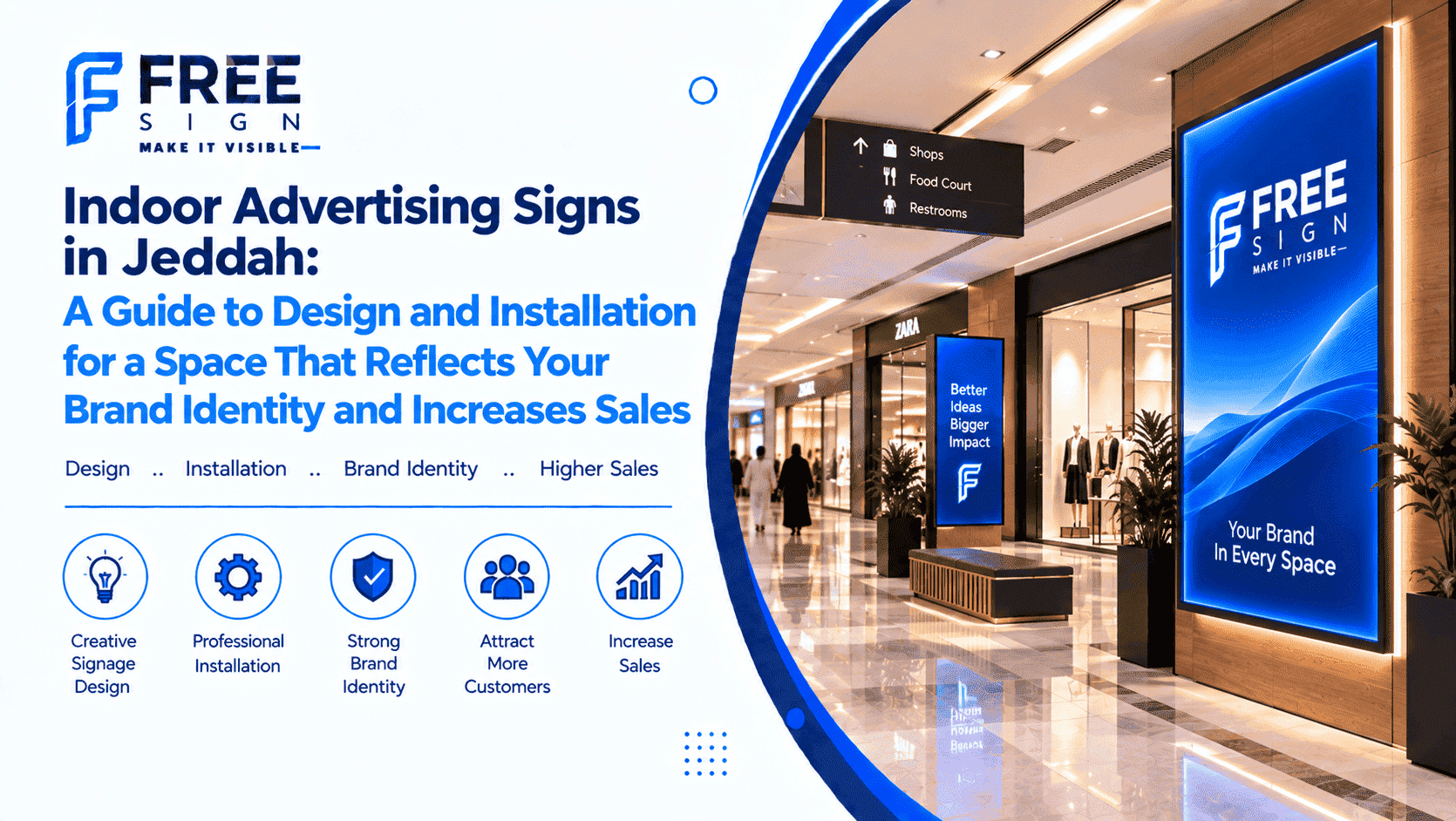
A customer stands at the entrance of your restaurant, office, or clinic and decides within moments whether the place deserves their trust. The sign behind the reception desk, on the lounge wall, or above the ordering area speaks for you before any employee says a word. A clear sign with well-executed lighting and clean materials conveys professionalism, while a faded or crooked sign sends the opposite message. In this guide, we cover everything you need to know about indoor advertising signs in Jeddah, including types, materials, lighting, design, costs, and how to choose the right contractor.
Keep in mind that the best results often come from combining two or three types of signs within the same space. For example, you could use illuminated raised letters at reception, acrylic signs for directions, and a digital screen for promotions, allowing each sign to serve the purpose it handles best.
What Are Indoor Advertising Signs?
Indoor advertising signs include any sign or visual element installed inside a building or facility to introduce a brand, guide visitors, or promote products and services. Unlike outdoor signs, they are viewed from a shorter distance and in more controlled conditions. They are not exposed to direct sunlight, dust, or wind, allowing for finer details and a wider variety of materials and finishes. These signs serve different purposes within the same facility, including:- Brand identity signs: The main logo sign, usually installed behind the reception desk or on the wall opposite the entrance.
- Directional signs: Guide visitors to departments, offices, restrooms, and exits.
- Promotional and product signs: Display prices, special offers, menus, and new products.
- Decorative signs: Enhance the appearance of a space and support its overall atmosphere, such as neon signs and inspirational quotes.
- Digital signs: Screens displaying animated content that can be updated easily.
Why Do Businesses in Jeddah Invest in Professional Indoor Signs?
Jeddah has a vibrant commercial, tourism, and service sector, with numerous restaurants, cafés, shopping centers, hotels, clinics, offices, and companies. Every business aims to stand out in the eyes of its customers. In such a competitive environment, visual details become a powerful advantage.First Impressions Are Formed Inside the Premises
Many businesses focus on their exterior storefronts and neglect the interior, even though visitors evaluate a place based on what they see after entering. Indoor signs are among the first things customers notice. When they are organized, clear, and consistent with the interior design, they help build trust in the business and its products.Making Your Brand Memorable
When customers see your logo and brand colors used consistently throughout your premises, your name becomes more firmly established in their minds, making it easier for them to remember you and return. Strategic visual repetition is one of the most effective tools for building brand recognition.Direct Influence on Purchasing Decisions
Promotional signs, menus, and product displays placed in the right locations can influence customers at the moment of purchase. A clearly illuminated menu above the ordering area speeds up decision-making, while a promotional sign near the checkout encourages customers to add one more item.Improving the Customer Experience and Reducing Confusion
In large facilities such as hospitals, shopping complexes, and multistory offices, clear directional signs reduce repetitive questions to staff and give visitors a greater sense of comfort and independence.Projecting a Professional Image to Business Partners
Companies that receive clients and business partners are directly affected by the appearance of their offices. A well-designed reception sign conveys stability and professionalism before a meeting even begins.Types of Indoor Advertising Signs and How to Choose the Right One for Your Business
Indoor signs come in many forms, each with its own appearance, applications, and cost. Understanding these options helps you choose the type that best serves your goals.3D Raised Lettering
These letters are made from acrylic, foam, Forex, or metal and mounted so they project from the wall. They can be illuminated or non-illuminated. Raised lettering gives logos a distinctive three-dimensional appearance and a premium look, making it one of the most popular choices behind reception areas. It is suitable for companies, clinics, hotels, and permanent exhibition spaces.Illuminated Signs (Lightboxes)
A lightbox is an enclosed sign with internal LED lighting that illuminates a printed or cut surface. It offers excellent visibility, even in dimly lit areas, and is suitable for menus, promotional displays, and large logos. One advantage is that the printed face can be replaced easily when the content needs updating.LED Neon Signs
LED neon signs replicate the appearance of traditional neon using flexible LED strips covered with silicone. They are lightweight, produce less heat, and consume less energy. They are widely used in cafés, restaurants, salons, and photo areas because they create an attractive, contemporary atmosphere. They work particularly well for short phrases, simple logos, and symbols.Acrylic Signs
Acrylic provides a clean, glossy surface and comes in a variety of colors. It is commonly used for reception signs, directional signs, and office nameplates. It can be printed using UV technology, laser-cut, or assembled in multiple layers to create distinctive visual depth.Metal Signs (Stainless Steel, Aluminum, and Copper)
Metal signs are ideal when a refined, premium appearance is required, such as polished gold or matte silver finishes. They are suitable for hotels, large companies, and administrative offices, offering durability and a long service life.Wooden Signs
Wood adds warmth and a natural character to a space, making it suitable for cafés, restaurants, and shops with a warm, contemporary design. Logos can be engraved, printed, or combined with backlighting to highlight details.Indoor Cladding Signs
These signs use composite panels combined with raised lettering or cut panels. They are suitable for large interior walls in shopping complexes, halls, and permanent exhibition spaces, creating a strong, organized appearance.Indoor Directional and Wayfinding Signs
These include signs for departments, floors, exits, restrooms, and meeting rooms. They require clear typography, strong contrast, and consistent, logical placement for quick reading. They are commonly made from acrylic, aluminum, or Forex.Digital Advertising Screens
Digital screens display animated content that can be updated quickly. They are suitable for changing promotions, digital menus, and branded content. Their installation requires planning for power supply, mounting, and content programming.Wall Stickers and Large-Format Printing
These provide an economical, fast solution for covering entire walls with graphics and brand visuals. They can be replaced easily when you want to refresh the space. The wall surface must be properly prepared to ensure the graphics adhere securely.Backlit Flex Signs and Indoor Banners
These signs are used to display large images and seasonal promotions. They are lightweight and easy to replace and can be mounted on lightweight metal frames or inside illuminated boxes.Where Should You Place Signs Inside Your Business? Examples by Industry
Choosing the right location for a sign is just as important as its design. Even an attractive sign will not serve its purpose if it is placed in the wrong location.Restaurants and Cafés
These businesses need a brand identity sign near the entrance or behind the cashier, clear menu boards above the ordering area, and a neon sign in a photo corner that encourages visitors to share pictures on social media, providing free publicity for the venue. Menus should also be readable from the queue.Offices and Companies
The logo sign behind the reception desk is the most important element, followed by signs identifying departments and meeting rooms. The design should be calm and organized, reflecting professionalism and trust.Clinics and Medical Centers
These facilities need clear directional signs with large lettering and calm colors, along with signs identifying specialties and doctors. Since visitors may be anxious or elderly, the information should be easy to read and understand without visual clutter.Shops and Retail Showrooms
Suitable options include department and shelf signs, promotional displays, and a main illuminated logo sign. Lighting should be arranged to highlight products without allowing the signs to overpower them.Salons, Beauty Centers, and Gyms
Neon signs, illuminated lettering, and glossy materials play a major role in creating the right atmosphere. Price lists and service packages can also be displayed in an elegant layout.Hotels and Resorts
These venues require premium materials, carefully planned warm lighting, and directional signs that complement the overall interior design. Refined details help communicate the quality of the service.Schools, Universities, and Training Centers
These facilities need clear signs identifying classrooms and departments, as well as motivational signs highlighting values and achievements. Safety must be considered, and signs must be securely mounted in areas with heavy foot traffic.Materials Used to Manufacture Indoor Signs
The quality of a sign and how long it maintains its original appearance depend on the materials selected. The following are the main materials and their key characteristics.Acrylic
Acrylic is available in transparent, colored, glossy, and matte finishes. It supports laser cutting, printing, and shaping. Its smooth surface creates a modern, elegant appearance, but it requires care to prevent scratches.Forex (PVC)
Forex is lightweight, easy to cut and print, and relatively affordable. It is suitable for lightweight raised lettering, directional signs, and decorative elements in indoor environments. It is a practical option when fast installation is required within a moderate budget.Aluminum and Composite Panels
These materials are durable, lightweight, and resistant to rust. They are used for sign panels, frames, and illuminated boxes. Composite panels are available in a variety of finishes to suit different design preferences.Stainless Steel
Stainless steel provides a premium appearance and high durability. It can be produced with polished or brushed finishes, as well as gold and rose-gold colors. Although it costs more, it lasts a long time and retains its elegant appearance.Wood and MDF
Wood and MDF offer warmth, are easy to shape, and can be painted or laminated. They are suitable for signs with a natural or classic appearance. Proper treatment is needed to protect them against moisture and scratches.LED Lighting
LED strips and modules are energy-efficient and produce relatively little heat. They are available in different color temperatures and can be used for backlighting, side lighting, and front lighting on letters and signs.Printing Films and Stickers
Printing films and stickers come in glossy, matte, transparent, and reflective finishes. The appropriate option depends on the surface and intended application. Film quality and ink type determine color retention and resistance to peeling.UV Printing
UV printing applies ink directly to acrylic, wood, metal, and Forex, delivering durable colors, high resolution, and fine details. It is particularly suitable for projects that require a refined finish and a durable printed surface.Lighting: The Element That Makes the Difference Between an Ordinary Sign and an Eye-Catching One
Lighting is not merely a decorative addition; it is part of the sign’s function. A sign that cannot be seen clearly fails to deliver its message, while excessive brightness strains the eyes and compromises the visitor experience.Front, Back, and Side Lighting
- Backlighting (Halo Lighting): Illuminates the letter from behind, creating a soft halo around the logo on the wall. It provides a subtle, luxurious look suitable for offices and hotels.
- Front Lighting: Illuminates the face of the letter directly, making it highly visible. It is ideal for shops and restaurants that want their names to stand out prominently.
- Double-Sided Lighting: Combines front and backlighting to highlight the letter while creating a surrounding halo.
- Side Lighting: Highlights the depth and edges of the letter, creating a distinct three-dimensional appearance.
Color Temperatures
Cool white lighting creates a clean, modern look suitable for clinics and technology businesses. Warm white lighting creates a comfortable atmosphere for cafés, restaurants, and hotels. Multicolored lighting works well in entertainment and creative spaces, provided it is not overused.Balancing Lighting With the Surrounding Space
The sign’s brightness should be adjusted to match the room’s lighting. An excessively bright sign in a dimly lit room can dazzle the eyes and disturb visitors, while a dim sign in a brightly lit space may disappear into the ambient lighting. For this reason, dimmer controls are recommended when needed.Heat and Safety
Use high-quality lighting sources and electrical transformers, ensure proper ventilation inside illuminated boxes, and secure all electrical connections within sealed enclosures. Electrical faults in indoor signs can put both people and property at risk.Principles for Designing an Indoor Sign That Communicates Clearly
Good design starts with understanding the sign’s purpose and audience, not with choosing colors and fonts.Define the Purpose Before the Appearance
Do you want to communicate your brand identity, direct visitors, or highlight an offer? Each objective requires a different approach to size, typography, and placement.Prioritize Clarity Over Decoration
Choose readable fonts and strong contrast between the background and text. Extremely thin or overly decorative fonts reduce readability, especially from a distance or under dim lighting.Choose a Size That Matches the Viewing Distance
The greater the viewing distance, the larger the letters should be. A sign designed to be read up close differs from one that must be visible from the other end of a hall. Measuring the actual distance at the site before approving the dimensions helps ensure readability.Maintain Visual Brand Consistency
Use the same logo colors and fonts across all indoor signs to create an organized, cohesive environment. Excessive variation in shapes and colors can undermine the space’s visual harmony.Keep the Wording Concise
The fewer words you use, the stronger the message can be. Include only the essential information and allow empty space to give the eyes a rest and draw attention to the most important element.Consider Both Arabic and English
In Jeddah, audiences are diverse, so using both Arabic and English is advisable for many businesses. Maintain consistent formatting, text direction, and font sizes. All text should be proofread before production, as a mistake printed on a wall can remain visible for years.Consider Height and Line of Sight
Signs are generally installed at a comfortable viewing height. Large reception signs should be positioned in relation to the furniture in front of them to ensure that desks or screens do not obscure any part of the design.Integrate the Sign With the Interior Design
A sign is not separate from its surroundings; it is part of the overall interior design. Wall colors, flooring materials, and furniture styles all influence the choice of material, lighting, and typography.Step-by-Step Process for Producing Indoor Advertising Signs
Professional sign production involves several interconnected stages, each of which affects the quality of the final result.Stage One: Understanding Requirements and Site Inspection
The sign provider begins by understanding your business and the purpose of the sign, then visits the site to assess the wall, available space, surrounding lighting, electrical points, and surface conditions. A site inspection helps identify details that may not be visible in photographs, such as uneven walls or pipes behind the surface.Stage Two: Design
An initial design is prepared to illustrate the appearance, colors, and dimensions. It is often presented as a mockup over a photograph of the actual wall, making it easier for the client to visualize the final result. Necessary revisions are made until the design receives final approval.Stage Three: Selecting Materials and Specifications
The material, thickness, lighting type, and installation method are determined based on the budget, intended use, and characteristics of the space.Stage Four: Manufacturing
Materials are cut using laser or other suitable machinery, graphics are printed, and letters and lightboxes are assembled. Lighting is installed and tested in the workshop. Testing the lighting before delivery can save considerable time later.Stage Five: Installation
The sign is secured using a method appropriate for the wall type, with electrical connections installed safely and wires concealed wherever possible. The installer must ensure that the sign is level and properly aligned, measuring distances accurately to prevent tilting.Stage Six: Inspection and Handover
The lighting is tested at different brightness levels, and the sign is checked for stability, cleanliness, and defects. It is then handed over to the client with instructions for use and care.Stage Seven: Maintenance and Support
The provider should remain available to address lighting failures, make adjustments, or update the sign’s content in the future. This is one of the most important factors when choosing a reliable sign company. Read also: Modern Shopfront DesignCost Factors: What Determines the Price of an Indoor Sign?
There is no single standard price for indoor signs because they vary significantly in design and specifications. However, several key factors determine the final cost:- Size: Larger signs require more materials and labor hours.
- Material Type: Stainless steel and thick acrylic generally cost more than Forex (PVC) and stickers.
- Lighting: Illuminated signs cost more than non-illuminated signs. The lighting type and number of lighting units also affect the price.
- Design Complexity: Interlocking letters, intricate details, and multiple layers increase production costs.
- Printing: The number of colors, printing method, and print quality all affect the price.
- Installation Method: Difficult walls, high ceilings, and glass surfaces may require additional work.
- Quantity: Large orders and repeat orders often receive better per-unit pricing.
- Required Turnaround Time: Very tight deadlines may require additional arrangements and costs.
Quick Comparison of the Most Common Types of Indoor Signs
The following table helps you make an initial comparison before discussing the details with your sign provider.| Type | Best Use | Main Advantage | What to Consider |
| Illuminated 3D Raised Letters | Reception signs and primary logos | Three-dimensional presence and a premium look | Requires careful electrical and installation planning |
| Lightbox | Menus, promotions, and large logos | High visibility and easy graphic replacement | Box thickness and lighting ventilation |
| LED Neon | Cafés and photo areas | Modern, eye-catching appearance | Best suited to short phrases |
| Acrylic | Reception areas and directional signs | Glossy finish and fine details | Susceptible to scratches during cleaning |
| Metal (Stainless Steel and Others) | Hotels and premium offices | Durability and a luxurious appearance | Relatively higher cost |
| Wood | Cafés and shops seeking a warm atmosphere | Natural, warm character | Requires moisture-resistant treatment |
| Digital Screen | Changing promotions and displays | Instant content updates | Requires programming and a power supply |
| Wall Sticker | Quickly covering large wall areas | Economical and fast | Requires a properly prepared surface |
Color Psychology in Indoor Signs
Colors are not just a matter of personal taste; they influence how visitors feel and behave within a space. Understanding their general associations can help you choose colors that suit your business:- Red and Orange: Associated with excitement, appetite, and speed, making them popular choices for restaurants, fast-food outlets, and promotional signs.
- Blue: Conveys trust, calmness, and professionalism. It is widely used by companies, banks, and clinics.
- Green: Symbolizes nature, health, and growth, making it suitable for health-related products and relaxing spaces.
- Black and Gold: Create a sense of luxury and distinction, making them ideal for hotels, perfume brands, and jewelry stores.
- White: Conveys cleanliness and simplicity and works well as a background that highlights other colors.
- Yellow: Attracts attention effectively and is useful for highlighting specific elements, such as promotions or warnings. However, excessive use can strain the eyes.
Indoor Digital Signage: When Is It the Best Choice?
Indoor advertising screens have become increasingly common in restaurants, exhibition spaces, hospitals, and offices because they combine visual appeal with flexibility. However, they are not the best solution for every situation. Here’s when digital screens are suitable and when a static sign may be sufficient.When Are Digital Screens Suitable?
- When your offers and prices change frequently and you want to update them instantly without reprinting.
- When you need to display introductory videos or animated visuals that attract attention.
- When you have a large number of products or services that are difficult to showcase on a static sign.
- In waiting areas where visitors spend longer periods viewing the content.
When Is a Static Sign Sufficient?
- For your primary brand identity sign, as a permanent, premium appearance often serves a logo better than animation.
- In small spaces that cannot accommodate a moving light source without creating distractions.
- When you cannot update the content regularly, since a screen displaying outdated information can do more harm than good.
Tips for Digital Content
Keep messages short and use large fonts. Avoid lengthy text that moves too quickly, update content regularly, and ensure that the colors match your brand identity. The screen should also be positioned away from windows and direct light sources to minimize reflections.Updating Your Signs for Seasons and Special Occasions
The market in Jeddah experiences recurring seasons that influence customer traffic and interests, including Ramadan, Eid al-Fitr, Eid al-Adha, sales seasons, and Saudi National Day. Businesses that update their indoor signs to reflect these occasions can demonstrate that they understand their audience and stay connected to its interests. This does not mean replacing the main sign every season. The primary brand identity sign should remain consistent. Instead, consider using changeable elements such as promotional signs with replaceable graphics, digital screens, seasonal wall stickers, or frames with easily updated content. This approach preserves your core brand identity while keeping the space fresh at a lower cost and with less effort.Preparing Design Files: What Does Your Sign Provider Need From You?
Sign projects are often delayed because files are missing or of poor quality. Preparing the required materials in advance can save days of back-and-forth communication and revisions:- Vector Logo Files: Provide AI, EPS, vector PDF, or SVG files. These formats can be scaled without losing quality and can be used directly for laser cutting.
- Brand Guidelines, If Available: These specify exact colors, fonts, and the permitted spacing around your logo.
- Final, Proofread Text: Ensure all Arabic and English content has been fully proofread before submission.
- Photos of the Space: Provide clear photos of the wall or installation area, along with approximate measurements. Ideally, include a photo taken from the angle at which visitors will see the sign.
- Color References: Supply color codes or printed samples when available, since colors can appear differently on screens and in real life.
- Target Deadlines: Specify the opening date or event before which the sign must be ready.
Indoor Signs and the Visitor Experience: Small Details That Make a Big Difference
Some businesses treat signs as purely decorative elements, while successful businesses recognize that signage is part of the customer’s journey through the space. This journey can be divided into several stages.Before Entering
Customers get a glimpse of the interior from outside. An indoor sign visible through a glass storefront may be the first element to catch their attention. Coordinate its lighting with your exterior signage to create a consistent first impression.Upon Entry
The sign facing the entrance or positioned behind the reception desk is often the most important sign in the space. Keep it simple, clear, and premium to match your brand, as this is the first opportunity to introduce your business to visitors.While Moving Around
Clear wayfinding signs help visitors feel comfortable and in control, especially in large facilities. They should follow a consistent sequence and design, with each intersection or corridor featuring a sign that confirms the correct direction.When Choosing and Purchasing
Menu boards, price signs, and promotional displays should be placed where customers make their decisions. They must be easy to read, well-lit, and organized logically to make comparing products easier.While Waiting
Waiting time is an excellent opportunity to share engaging content or useful information about your services through screens or informational signs. This turns idle moments into opportunities for customers to learn more about your brand.When Leaving
An elegant thank-you message or a sign inviting customers to follow you on social media or visit again can leave a positive impression and encourage repeat visits. Read also: How to Design Road Directional SignsElectrical Safety and Quality in Illuminated Signs
Illuminated signs contain electrical components that require careful handling, even when they use low-voltage LED lighting. Here are the key factors to consider:- Quality of Transformers and Power Supplies: Poor-quality transformers are a common cause of lighting failures and inconsistent brightness. Choose reliable power supplies with a capacity appropriate for the electrical load.
- Insulation and Connections: Properly insulate connections and protect them from moisture and dust. Organize the wiring inside the sign enclosure rather than leaving it loose or tangled.
- Ventilation: Enclosed lightboxes need small ventilation openings or a design that allows heat to dissipate.
- Grounding and Protection: Follow proper grounding practices and protect the electrical circuit with suitable circuit breakers.
- Maintenance Access: Design the sign so it can be opened and inspected without completely dismantling it.
- Secure Mounting: Calculate the weight and choose the correct mounting method, especially for large metal signs suspended from drywall or suspended ceilings.
Indoor Signage Budget: How to Allocate Your Spending Wisely
Whether you are opening a new branch or renovating an existing space, allocating your signage budget requires an overall perspective. Consider prioritizing your spending as follows:- Primary Brand Identity Sign: Allocate the largest share of your budget to this sign, as it is the most important visual element in your interior and is seen during every visit.
- Essential Operational Signs: Prioritize menus, directional signs, and price displays because they affect the customer experience and daily operational efficiency.
- Decorative Signs: Neon signs and photo areas enhance the atmosphere but can be postponed or implemented in stages.
- Seasonal and Changeable Elements: Set aside a small, recurring budget for seasonal campaigns and promotions.
- Maintenance and Updates: Reserve a modest amount to keep signs in good condition and replace faulty components when necessary.
Modern Trends in Indoor Sign Design
Interior design preferences continue to evolve, and these changes are reflected in signage styles. Here are some trends you can adapt to suit your business:- Minimalist Design: Clean lines, limited colors, and comfortable negative space create a refined, understated appearance.
- Layered Letters: Multiple layers of acrylic or metal in contrasting colors create eye-catching visual depth.
- Natural Materials With Modern Lighting: Combining wood and stone with concealed LED lighting creates a balance between warmth and contemporary style.
- Interactive Signs: Signs that respond to movement or touch, or display content that changes according to the time.
- Carefully Planned Colored Lighting: Using one distinctive color to define a specific area instead of relying on multiple colors.
- Full Customization: Moving away from ready-made templates toward designs that reflect the brand’s personality and distinguish it from competitors.
How to Choose a Provider for Your Indoor Signs
Choosing a sign provider is just as important as choosing the design itself. Even the most attractive concept can fail if it is produced using poor-quality materials or installed inaccurately. To evaluate a provider, ask yourself the following questions:- Do they have their own manufacturing workshop? Providers that manufacture in-house generally have better control over quality and deadlines than those that outsource every stage to third parties.
- Can they show you genuine previous projects? Request photos of completed work similar to your project, and visit the site in person if possible.
- Do they inspect the site before providing a quotation? Pricing without an inspection may conceal additional costs that emerge later.
- Is the quotation detailed? It should specify the material, thickness, lighting type, installation method, and production timeline.
- Do they clearly explain their warranty and maintenance policies? A company confident in its work should be willing to clarify what happens after handover.
- Do they answer technical questions clearly? Clear, direct explanations are a positive sign, while evasive answers should raise concerns.
- Do they meet agreed deadlines? Ask about previous customers’ experiences with the provider’s ability to meet project schedules.
Traditional Printing vs. UV Printing: Which Is Better for Your Sign?
Several printing technologies are used for indoor signs, most notably adhesive vinyl printing and direct UV printing. Each has its own applications.Adhesive Vinyl Printing
Graphics are printed onto an adhesive film, which is then applied to the surface. This method is fast and suitable for large surfaces, walls, glass, and panels. It works well for projects requiring quick turnaround at a moderate cost. However, adhesion quality depends heavily on surface preparation, and the edges may peel over time if the installation is not carried out properly.Direct UV Printing
In this method, colors are printed directly onto the material and cured using ultraviolet light, helping them bond securely to the surface. UV printing offers sharp detail, good color consistency, and scratch resistance. It is suitable for acrylic, wood, metal, Forex (PVC), and signs that require a refined, long-lasting finish. It is often the better choice when quality and durability are priorities. For many projects, professional providers use both methods: UV printing for detailed elements and primary signs, and vinyl printing for large surfaces and quick coverage.Three Practical Scenarios for Indoor Signage
The following hypothetical examples illustrate how signage choices can be tailored to different types of businesses.Scenario One: A New Café in a Residential Neighborhood
The café owner wants a warm, contemporary atmosphere that appeals to young people and families. A suggested solution includes a wooden name sign with warm backlighting behind the ordering area, a simple menu board with clear typography above the cashier, and a neon sign featuring a short phrase in a dedicated photo area. The result is a cohesive space that encourages visitors to take photos and share them online, turning the signs into a form of organic promotion.Scenario Two: A Specialist Clinic
The clinic needs a calm appearance that inspires confidence. A suggested solution includes a white raised-letter logo with soft backlighting behind reception, acrylic directional signs with large fonts and calming colors for rooms and departments, and an elegant information board listing the clinic’s specialties and doctors. The design should be easy for older visitors and patients to read, while avoiding harsh colors that may create anxiety.Scenario Three: A Company With an Administrative Office
The company wants to project a serious and trustworthy image to clients and business partners. A suggested solution includes a brand identity sign made of metal letters or layered acrylic on the reception wall, consistently designed signs identifying departments and meeting rooms, and possibly a small screen in the waiting area displaying information about the company and its projects. The result is an organized, professional impression that communicates stability. You can adapt these ideas to your business type, available space, and budget. The key is to assign a clear purpose to every sign rather than installing disconnected signs without an overall plan.Pre-Installation Checklist
Preparing the site before the installation team arrives saves time and helps ensure better results.- Clear the installation area: Remove furniture, displays, equipment, and any other obstacles that may restrict access.
- Identify the power source: Confirm the location of the electrical outlet or ensure that a suitable power supply is accessible near the illuminated sign.
- Review approvals: This is particularly important in shopping malls and rented buildings. Make sure installation is permitted at the scheduled time.
- Agree on a suitable time: Installation outside business hours is often preferable to avoid disruption and distractions.
- Prepare the access route: This is especially important for large signs that require wide entrances or suitable elevators.
- Review the final design: Check the text, colors, and dimensions one last time, as changes after installation can be costly.
- Assign a responsible contact person: Have someone available to answer questions during installation and inspect the completed work before accepting it.
Installation Differences for Various Wall Types
A sign’s stability depends on understanding the surface on which it will be mounted. Each wall type requires a different installation method.- Concrete and block walls: These can support heavy loads and typically require suitable screws and wall anchors selected according to the sign’s weight.
- Drywall walls: These have a lower load-bearing capacity and may require specialized anchors, additional supports, or attachment to the metal framework behind the drywall, particularly for large or metal signs.
- Glass surfaces: These require specialized adhesive or mounting systems that account for the sign’s weight and the safety of the glass. Installation should preferably be handled by an experienced team.
- Marble and tiled surfaces: Drilling requires suitable tools to prevent cracking or breakage.
- Wood and decorative wall cladding: The mounting method depends on the cladding’s thickness and the supporting structure behind it.
Common Mistakes When Producing Indoor Advertising Signs
Repeated mistakes can weaken the impact of indoor signs and force business owners to pay for corrections or replacement.Estimating the Size Without Accurate Measurements
A sign that is too small may get lost against the wall, while one that is too large can overwhelm the space. Accurate measurements and a mockup before production help prevent this mistake.Ignoring the Surrounding Lighting
A sign that is too bright or too dim relative to the room’s lighting loses its effectiveness.Overloading the Design With Elements
Crowding a sign with text, images, and colors distracts visitors and weakens the message.Using Low-Quality Design Files
A low-resolution logo can appear blurry when enlarged. Using vector files for the logo is essential for high-quality cutting and printing.Ignoring the Wall Type
Drywall, glass, and marble require different mounting methods. Incorrect installation can cause the sign to fall or damage the wall.Using Unsafe Electrical Connections
Poorly arranged wiring or low-quality transformers can cause recurring faults and create safety risks.Neglecting Future Updates
Promotional signs and menus often need to change. Choose solutions that allow the surface or content to be replaced without manufacturing the entire sign again.Choosing the Cheapest Option Without Comparing Specifications
Price differences often reflect differences in materials, lighting, or finishing quality. These differences can quickly become apparent in the sign’s performance and appearance.Reusing and Refreshing Signs Instead of Replacing Them Entirely
Not every change to a space requires a completely new sign. In many cases, an existing sign can be refreshed at a lower cost and in less time, making this a practical and environmentally friendly option. Examples include:- Replacing the printed face of a lightbox: Keep the existing box and lighting, replacing only the printed panel when promotions or menus change.
- Repainting or recoloring letters: Update the appearance without manufacturing new letters.
- Replacing only the lighting units: If the light becomes dim or some units fail, renew the lighting without replacing the rest of the sign.
- Relocating the sign: After rearranging the space, moving the sign to a more suitable wall may be sufficient.
- Adding a new layer to an existing sign: Introduce a new phrase or secondary logo without changing the underlying structure.
Questions to Ask Before Every Signage Project: Assess Your Readiness
Before contacting a sign provider, try answering the following questions. Clear answers will make discussions faster, more accurate, and less prone to misunderstandings.- What is the sign’s primary purpose: identification, wayfinding, promotion, or decoration?
- Who will see it, and from what distance and viewing angle will they read it?
- What are the exact dimensions of the wall or available space?
- Does the sign need lighting? If so, is a nearby power source available?
- What colors and fonts are specified in your brand identity? Do you have vector logo files?
- Will the sign’s content change in the future, or will it remain permanent?
- What is your approximate budget, and how much time is available before the required completion date?
- Are there any building management or property owner requirements that must be followed?
Wording and Text Mistakes That Weaken Indoor Signs
Many visually attractive signs are undermined by poorly written or unproofread text. This is an issue that business owners often overlook amid the many project details. Common mistakes include:- Spelling and grammatical errors: A single mistake on a reception wall can be noticed by everyone and damage your professional image. Review the text several times and, ideally, have more than one person proofread it.
- Excessively long text: A sign is not a brochure. Condense the message into a few strong words.
- Mixing two languages without consistent formatting: Arranging Arabic and English text randomly can confuse readers and weaken visual consistency.
- Inconsistent naming: Using different versions of your business or service name in different locations makes your brand harder to recognize.
- Generic, meaningless phrases: Repeated slogans that add no real value are less effective than specific wording that communicates a genuine business advantage.
- Outdated numbers and information: Old prices, phone numbers, or opening hours can cause embarrassment and undermine customer trust.
How to Keep Your Indoor Signs in Excellent Condition
Maintenance is simple, but it can extend the life of your signs and preserve their appearance.- Regular cleaning: Use a soft cloth and gentle cleaning products. Avoid abrasive materials that can scratch acrylic and glossy surfaces.
- Lighting inspection: Monitor the lighting units and replace faulty ones promptly to prevent letters from appearing incomplete or unevenly illuminated.
- Check mounting stability: Inspect the sign periodically, especially in high-traffic areas.
- Protect against moisture: Avoid exposing wooden signs to direct moisture and maintain adequate ventilation in enclosed spaces.
- Update content: Replace promotional signs and menus when they expire. Displaying outdated information can create an impression of neglect.
Approvals and Regulatory Considerations to Know
Requirements for indoor signs vary according to their location. In shopping malls and rented buildings, approval from building management or the property owner is often required before installation, including approval of the sign’s position, mounting method, and specifications. When lighting or electrical connections are involved, the installation must comply with the facility’s applicable electrical safety and fire protection standards. Signs facing the street or visible from outside may also be subject to requirements imposed by the relevant municipal authorities. If a sign is near a storefront or glass facing outdoors, it is advisable to check with the appropriate authority before proceeding. Discussing these matters with your sign provider in advance can save time and prevent costly modifications after installation.How to Measure the Impact of Indoor Signs on Your Business
It can be difficult to measure the precise impact of an individual sign, but several practical indicators can help:- Observe visitor behavior: Do visitors stop to look at the sign? Do they take photos of it?
- Track reductions in recurring questions: After installing directional signs, compare the number of inquiries received by staff.
- Monitor sales of promoted products: Compare sales of products featured on clear promotional signs before and after installation.
- Track social media engagement: If you have a neon sign or photo area, monitor the number of published photos that feature your business name.
- Collect customer feedback: Ask customers for their opinions or monitor comments about the atmosphere and organization of your space.