
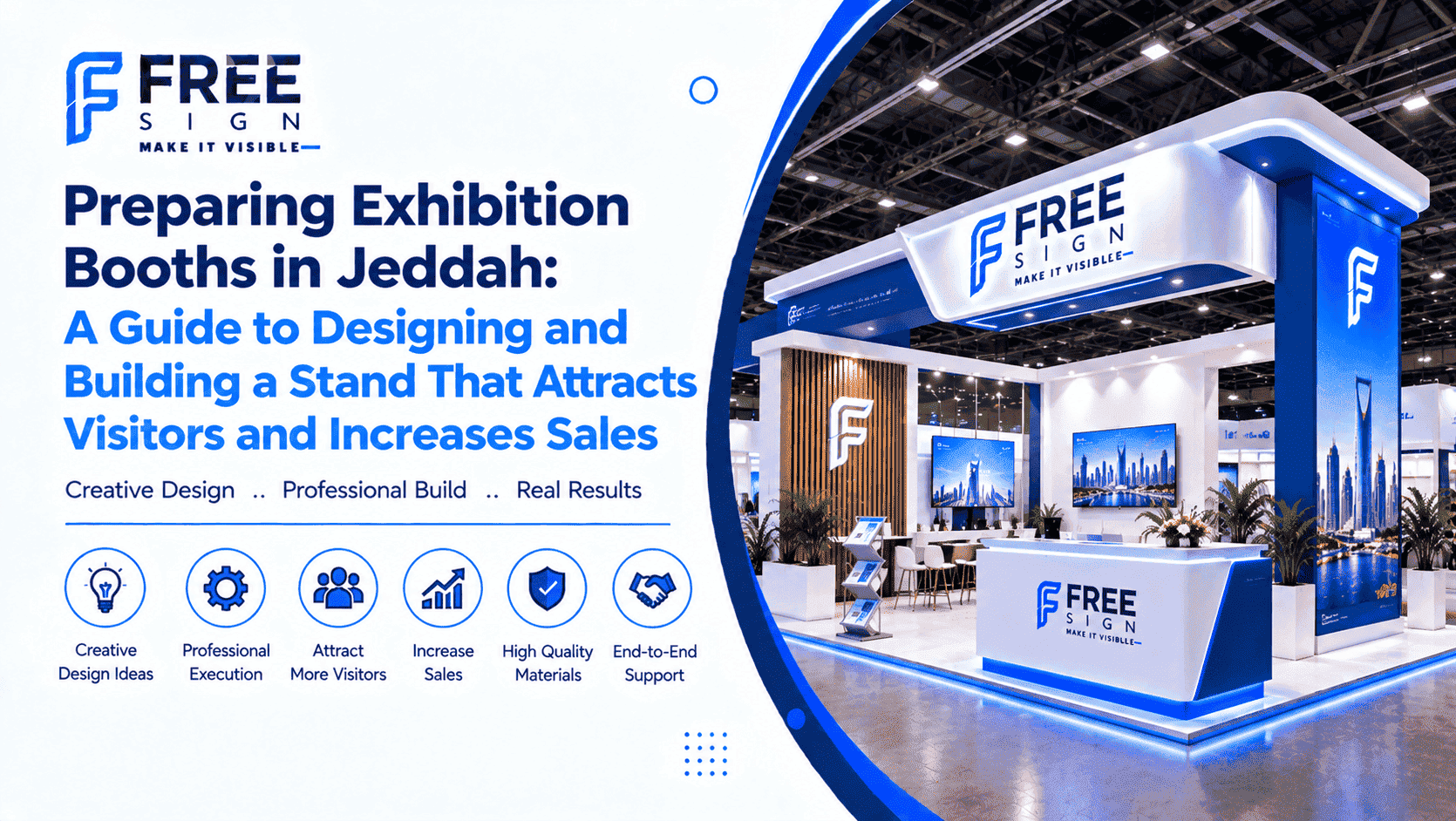
Visitors enter an exhibition hall filled with hundreds of booths, and they rarely give any single stand more than three seconds before deciding whether to stop or keep walking. Those few seconds can determine whether your investment in the exhibition generates genuine leads or gets lost in the crowd. That is why exhibition booth preparation is not simply about building a structure and printing a logo. It is about engineering a complete experience that begins with the booth concept and ends with a successful sales conversation. In this guide, we explain everything you need to know about creating a professional exhibition booth in Jeddah, from booth types, materials, and design to costs and common mistakes that undermine exhibitors’ results.
What Is Exhibition Booth Preparation, and What Does It Actually Include?
Exhibition booth preparation refers to the integrated range of services that transform an empty space inside an exhibition hall into a fully equipped display stand that reflects a company’s identity and supports its marketing and sales objectives. Some may assume the process involves nothing more than installing walls and printing a sign, but the reality is much more comprehensive. It covers planning, design, manufacturing, transportation, installation, operation, and dismantling after the event ends. When we talk about preparing a complete exhibition booth, we typically mean the following elements:- Booth structure: Walls, raised flooring, ceilings, and overhead frames, made from wood, aluminum, or a combination of both.
- Printing and visual identity: Logos, graphics, and high-resolution printed backdrops that match the brand’s colors.
- Lighting: General lighting, focused product lighting, and decorative lighting that creates a distinctive visual atmosphere.
- Furniture and displays: Counters, reception areas, meeting tables, display shelves, and showcases.
- Screens and technology: Display screens, sound systems, and interactive presentation equipment.
- Flooring and finishing: Carpeting, parquet, or specialized flooring, along with painting and final finishing work.
- Logistics: Transporting components to the exhibition venue, installing them on schedule, and dismantling and returning them after the event.
Why Do Exhibitors in Jeddah Need a Professionally Designed Booth?
Jeddah holds a distinctive position in Saudi Arabia’s business landscape. As a major commercial gateway on the Red Sea, it is a vital hub for trade, services, tourism, hospitality, and retail. With the rapid growth of the exhibitions, conferences, and events sector under Saudi Vision 2030, companies and brands are competing for a stronger presence at these events. Simply setting up a table and displaying a logo is no longer enough to convince visitors to engage.Competing for Attention
At any major trade show, dozens of exhibitors from the same industry may be positioned next to one another, often presenting products with similar features and prices. In this environment, the booth itself becomes the first means of differentiation. An organized stand with a clear message and a visual story captures visitors’ attention before any sales representative speaks, while visitors are likely to walk past a crowded booth with an unclear message.The First Impression of Brand Quality
Visitors often judge a company’s products and services by the quality of its booth, whether they realize it or not. A crooked sign, faulty lighting, faded printing, or untidy flooring can all undermine confidence before a business conversation even begins. In contrast, precise execution and attention to detail convey professionalism and reliability, helping facilitate negotiations and accelerate purchasing decisions.Return on Investment in Exhibition Participation
The cost of participating in an exhibition extends beyond the price of the reserved space. It also includes travel, operations, staffing, marketing materials, and the booth itself. If the booth is poorly designed, all these expenses lose a significant portion of their value. Savvy exhibitors therefore view the booth preparation budget as a multiplier that increases the return on their other investments, rather than an expense to cut merely to save a small amount.The Specific Characteristics of the Jeddah Market
Exhibition audiences in Jeddah are highly diverse. They include local business owners, visitors from across Saudi Arabia, international guests, and various groups of end consumers at public exhibitions. This diversity calls for a design with a clear message that is easy to read, bilingual when necessary, and carefully planned to accommodate high visitor traffic during peak days.Types of Exhibition Booths: How Do You Choose the Right One for Your Event?
Exhibition booths vary according to space, budget, event type, and participation objectives. Understanding the available options helps you request a solution that genuinely meets your needs rather than choosing a design that may not be suitable.Custom Wooden Booths
Custom wooden booths offer the greatest design flexibility, allowing them to be built at different heights, with curved surfaces and multiple levels, and finished with various paints and materials. They are suitable for major exhibitions and conferences where exhibitors want a distinctive stand that stands out from the competition. They also offer stability, durability, and a premium appearance. However, wooden booths generally require longer manufacturing times and have relatively higher costs. Reusing them at future exhibitions may also require modifications.Aluminum Booths (Modular System)
These booths use lightweight aluminum frames assembled through a connection system and covered with printed panels or infill walls. Their main advantages include quick installation and dismantling, low weight, and repeated reuse by changing only the printed graphics. They are suitable for companies participating in multiple exhibitions throughout the year that want to reduce long-term costs. They are also a practical choice for fast-paced events and traveling exhibitions.Modular Exhibition Booths
Modular booths combine the flexibility of aluminum systems with expandability. They are built from units that can be rearranged and resized according to the space available at each exhibition. This solution is particularly practical for companies that exhibit in different-sized spaces, allowing them to use the same system for a small stand and expand it for a larger event.Island Booths
An island booth is open on all four sides, offering visitors a 360-degree view from every direction. Its design must account for the visibility of every side, leaving no neglected back or side panel. It also requires intelligent planning of visitor flow and supporting services. Island booths are suitable for major brands seeking a commanding presence and broad visitor engagement.Corner Booths and Inline Booths
A corner booth is open on two sides, benefiting from two angles to attract attention. An inline booth, by contrast, is open on only one side and is the most common and generally least expensive option. An inline booth requires a strong front-facing design because this is the only side available for visual communication with visitors.Small Display Stands and Counters
For exhibitors with limited budgets or space, compact stands can be built with a printed backdrop, a reception counter, and display shelves. Despite their small size, well-designed stands can be highly effective, particularly at exhibitions where exhibitors are allocated similarly sized standard spaces.Conference and Event Staging
This category includes stage backdrops, raised platforms, speaker podiums, and entrance gateways. These elements are often produced alongside exhibition booths to ensure visual consistency throughout the event. Timing is especially critical for this type of work because any delay can affect the entire event schedule. Read also: Modern Shopfront DesignExhibition Booth Preparation Stages: From Concept to Opening Day
Building a successful exhibition booth is a sequential process in which each stage matters. The more closely the execution team follows this sequence, the fewer unpleasant surprises are likely to arise before opening day.Stage One: Define Objectives and Understand the Exhibition
Before drawing any design, several essential questions must be answered: What is the primary objective of participating? Is it to generate leads, close deals, or increase brand awareness? Who is the target audience? Which products or services will be displayed? How large is the team working inside the booth? The answers determine how the space should be allocated. A booth designed for closing deals needs quiet meeting areas, while one intended for quick introductions requires open display areas and interactive counters.Stage Two: Review Exhibition Requirements and Available Space
Every exhibition provides an exhibitor manual specifying maximum permitted heights, load limits, electrical requirements, contractor access times, and transportation and storage policies. Ignoring these requirements is one of the most common reasons designs are rejected or require last-minute modifications. A professional execution team therefore begins by carefully reviewing these documents before approving the final design.Stage Three: Three-Dimensional Design
The creative concept is transformed into 3D models showing the booth from multiple angles, including the visitor’s perspective when approaching from the main aisle. These models allow the client to visualize the final result before manufacturing begins and make changes to colors, dimensions, screen locations, and lighting without significant additional costs. Technical drawings for the manufacturing team are also prepared at this stage.Stage Four: Approve the Bill of Quantities and Specifications
At this stage, the type, thickness, and quantity of each material are specified, along with the lighting and screen types and printing details. Approving these specifications helps control costs accurately and avoid unexpected additions. It also ensures that the finished booth matches what the client agreed to.Stage Five: Workshop Manufacturing
Actual production begins with cutting and shaping materials, printing graphics, and assembling the units provisionally in the workshop to verify dimensions and ensure that all components fit together correctly. Trial assembly is essential because it saves hours of work inside the exhibition hall. Identifying an error in the workshop is much easier than discovering it under the pressure of a tight exhibition setup schedule.Stage Six: Transportation and On-Site Installation
The disassembled units are transported to the exhibition hall according to the organizer’s schedule. The installation team then assembles and secures the structure, installs lighting, screens, and flooring, and completes the final printing and finishing touches. Precise timing is critical at this stage because exhibition installation windows are usually limited and leave little room for delays.Stage Seven: Final Inspection and Handover
Before the exhibition opens, every element is inspected, including structural stability, electrical connections, screen and lighting operation, surface cleanliness, and print clarity. The booth is then handed over to the client, along with a brief explanation of how to operate the technical equipment and guidance on handling unexpected issues during the exhibition.Stage Eight: Support During the Exhibition and Dismantling Afterward
Some booths require technical support throughout the exhibition to address unexpected faults. After the event, the booth is dismantled according to the organizer’s schedule, and reusable components are transported to storage or the workshop for future use.Materials and Technologies Used in Professional Exhibition Booth Manufacturing
Material quality is evident in every detail of a booth, from the stability of its walls to the clarity of its printed colors. The following are some of the main materials and technologies used in professional booth production.Engineered Wood
MDF and treated wood are widely used to manufacture booth structures and walls because they are easy to shape and have smooth surfaces suitable for painting and laminating. Quality depends on selecting the appropriate thickness and treating the edges against moisture, as untreated wood may be affected by environmental changes during transportation and storage.Aluminum Structures
Aluminum profiles provide lightweight construction and structural strength, making them the foundation of reusable exhibition booth systems. They are easy to assemble and dismantle without complicated tools and can withstand repeated transportation and use at multiple exhibitions.Forex, Acrylic, and Plastic Panels
These panels are used to produce signs, raised lettering, and decorative elements. Forex is lightweight, easy to cut, and suitable for direct printing, while acrylic offers a premium glossy appearance and is widely used for illuminated letters and display features.UV Printing Technology
UV printing is one of the best solutions for producing booth graphics. It prints directly onto various materials, delivering vibrant, durable colors and high resolution. Compared with traditional stickers, it offers greater resistance to scratches and fading. This technology also makes it possible to reproduce fine details and color gradients that clearly highlight a brand’s visual identity.Laser Cutting and CNC Machines
These technologies enable the precise cutting of complex shapes, decorative patterns, and lettering with exceptionally clean edges, giving booths a professional appearance that is difficult to achieve with manual tools. They also allow complex geometric designs to be reproduced consistently, which is particularly important when manufacturing multiple identical units.Metal Bending and Perforation
Metal is used to manufacture support structures, frames, brackets, display shelves, and decorative elements. Perforated metalwork adds a distinctive aesthetic dimension when combined with backlighting, producing attractive patterns and shadows.Paints and Finishes
Paint quality determines a booth’s final appearance and its ability to withstand use. Paints cured in specialized ovens provide better adhesion and longer-lasting finishes, creating a uniform surface free of visible defects. This is particularly important under the powerful lighting used in exhibition halls, which can reveal even minor inconsistencies in the paintwork.LED Lighting
LED lighting offers high efficiency, low energy consumption, and reduced heat output. It also provides extensive control over color temperature and brightness. This makes it ideal for highlighting products and creating different atmospheres within a booth without the risks associated with excessive heat.Design Principles for an Exhibition Booth That Attracts Visitors and Achieves Its Goals
Effective booth design is not just about visual impact. It requires an understanding of visitor behavior and a plan to guide people step by step from passing by to engaging with the booth and starting a business conversation.The Three-Second Rule
A booth needs a clear visual message that visitors can understand immediately from the aisle. This can be achieved with a large logo positioned high enough to be visible, a short headline explaining the company’s business, and strong colors consistent with the brand identity. Too much text or too many images can obscure the message and cause visitors to walk past without understanding what is being offered.Visitor Flow Within the Booth
Visitors should be able to enter the booth easily and move through it smoothly. Narrow entrances and excessive obstacles discourage visitors, especially during busy periods. It is better to leave a wide, open entrance and arrange the elements to guide visitors through a sequence of areas: an initial attraction zone, a display and interaction area, and finally a conversation or meeting area.Reception Area
The reception counter or desk is the first point of human contact, so it should be clearly positioned, accessible, and unobstructive. Ideally, it should include space for collecting visitor information and displaying promotional materials, while maintaining a design that complements the rest of the booth.Consistent Visual Identity
Consistency in colors, fonts, and symbols across the booth, printed materials, and staff uniforms strengthens brand recognition and creates a sense of organization. Conflicting visual elements weaken the message and make the brand appear disjointed.Making Use of Height
In crowded exhibition halls, elevated elements such as suspended signs, tall columns, and overhead frames can attract attention from a distance, above visitors’ heads. However, all designs must comply with the maximum heights permitted under the exhibition regulations.Social Spaces and Privacy
A successful booth balances open areas for quick interactions with enclosed or semi-enclosed spaces for more serious meetings. A quiet corner with comfortable seating can make the difference between a brief conversation and a completed deal.Considering the Needs of the Team
Many attractive designs overlook the needs of the staff working inside the booth. There may be no storage for materials, no place to keep personal belongings, or no space for short breaks. Allocating a small storage room behind the booth helps keep the public area tidy and gives the team greater comfort, which can improve its performance when interacting with visitors.Lighting, Screens, and Interactive Technologies Inside the Booth
Technology has become an essential part of modern exhibition booths. It attracts attention, makes products easier to explain, and helps collect visitor data.Lighting as a Design Tool
Lighting does more than illuminate a space; it directs visitors’ attention. Focused lighting highlights product details, backlighting makes a logo visible from a distance, and warm lighting in a meeting area creates a comfortable atmosphere. Lighting should be positioned carefully to prevent distracting glare on screens and harsh shadows on people’s faces.Digital Screens
Display screens can show introductory videos, product demonstrations, and animated advertisements. They are particularly useful when showcasing products that are difficult to bring physically to the exhibition. Content should be short, loop continuously, and remain understandable without sound, since noise inside exhibition halls makes audio-dependent content less effective.Interactive Presentations
Touchscreens, augmented reality experiences, and simple brand-related games can increase the time visitors spend at a booth and create a positive, memorable experience. These activities should ideally be connected to the product or service rather than serving as entertainment unrelated to the marketing objective.Electrical Planning
Booths that rely on screens and lighting require careful electrical planning to determine outlet locations and equipment loads. Electricity connections should be reserved in advance through the exhibition organizer based on actual requirements, with backup solutions available in case of unexpected failures. Read also: How to Design Road Directional SignsSafety Requirements and Regulatory Guidelines for Exhibitions
Safety is an integral part of any professional booth setup. Exhibition halls accommodate large numbers of people, so organizers and relevant authorities impose strict requirements.- Fire safety: Appropriate materials must be selected, emergency exits and firefighting equipment must remain unobstructed, and all instructions issued by Civil Defense and the event organizer must be followed.
- Structural stability: The booth must be stable and securely installed. Suspended elements must be safely supported and capable of bearing their weight, particularly in crowded areas with constant visitor movement.
- Electrical safety: Electrical installations require suitable cables, proper grounding, and protection against overloads. Exposed cables must not be left across pedestrian routes.
- Height and space limits: The maximum height and allocated space specified in the participation agreement must be respected. Booths must not encroach on visitor aisles or neighboring stands.
- Accessibility: The design should accommodate people with disabilities and older visitors wherever possible by providing wide entrances and level flooring free of obstacles.
Cost Factors in Exhibition Booth Preparation
There is no single standard price for preparing an exhibition booth. The final cost varies according to several factors that should be understood before requesting a quotation.- Booth size: Larger spaces require more materials and additional labor hours.
- Structure type: Custom wooden booths generally cost more than ready-made aluminum systems, but they offer greater design flexibility.
- Design complexity: Curved surfaces, multiple levels, suspended elements, and specialized finishes increase costs.
- Screens and technology: The number and size of screens, sound systems, and interactive experiences all affect the budget.
- Lighting: Costs depend on the type and quantity of lighting and the complexity of its controls.
- Furniture and flooring: Reception counters, chairs, tables, and the selected flooring material influence the total cost.
- Printing: Costs vary according to the printed area, material, and print quality.
- Available time: Tight deadlines may require overtime and additional workers.
- Transportation and installation: The distance between the workshop and exhibition venue, permitted installation hours, and the number of technicians required all affect the price.
- Reusability: Investing in a reusable structure increases the initial cost but can reduce expenses at future exhibitions.
Common Mistakes in Exhibition Booth Preparation and How to Avoid Them
Certain mistakes occur repeatedly at exhibitions. Avoiding them can save you money and time while protecting your company’s reputation.Starting Too Late
Some exhibitors begin planning only a few weeks before the exhibition, forcing them to rush production and compromise on quality. Early planning allows sufficient time for thoughtful design, precise manufacturing, and necessary revisions.Ignoring the Exhibitor Manual
Booths are often designed to exceed permitted height limits or violate electrical and suspension requirements. As a result, they may be rejected or modified at the exhibition venue, leading to significant additional costs and effort.Visual and Textual Clutter
Trying to display every product and piece of information in one booth overwhelms visitors. One clear message is more effective than ten competing messages.Overlooking Usable Space
A booth may look attractive but become frustrating if it is too narrow to accommodate both the reception team and visitors. The expected number of people inside the booth at any given time must be considered during planning.Using Images That Do Not Match Real-World Requirements
Printed images enlarged from low-resolution files appear blurry under exhibition hall lighting. High-quality image files are essential for clean, professional printing.Completely Overlooking Storage
Without a designated place for boxes and promotional materials, the public area becomes cluttered, undermining the booth’s overall appearance.Failing to Test Technical Elements Before Opening
A malfunctioning screen, lighting that cannot be controlled, or intermittent audio can ruin the first impression. These problems are easily identified through preliminary testing.Choosing a Contractor Based on Price Alone
The lowest quotation may conceal cheaper materials or exclude essential services. The difference often becomes apparent later through poor quality or unexpected additional costs.Practical Pre-Exhibition Checklist: A Suggested Timeline
Dividing the work into time-based stages helps ensure everything is completed calmly and without unnecessary pressure. The following is a general timeline that can be adapted to the scale of your participation.- Well before the exhibition: Define objectives and budget, obtain the exhibitor manual, and contact the execution company to begin the initial assessment.
- Design stage: Approve the concept, 3D models, final specifications, and bill of quantities.
- Manufacturing stage: Begin workshop production, conduct periodic reviews, request progress photos, and complete a trial assembly of the structure.
- Shortly before installation: Confirm the installation schedule with the exhibition organizer, arrange access permits for technicians, inspect all components, and package them for transportation.
- Installation days: Supervise installation, test lighting and screens, arrange displays, and prepare the team.
- During the exhibition: Check the booth’s condition and cleanliness daily, ensure presentations are ready, and maintain a technical contact for emergencies.
- After the exhibition: Dismantle the booth according to the schedule, store reusable components, and evaluate performance to improve future participation.
How to Measure Exhibition Success and Booth Return on Investment
Preparing the booth is not the end of the process. The more important question is: What did the booth actually achieve? To answer accurately, define clear performance indicators before the exhibition.- Number of booth visitors: Estimate this figure through manual counting or a simple visitor tracking system.
- Number of qualified leads: Visitors who provided their contact details and demonstrated genuine interest in your product or service.
- Number of meetings scheduled: Appointments arranged during the exhibition for follow-up afterward.
- Direct sales or contracts: Deals concluded at the exhibition or during the following weeks as a result of participation.
- Digital engagement: The number of people who visited your pages or followed your social media accounts after the exhibition.
- Feedback from staff and visitors: Comments on booth clarity, ease of interaction, and comfort.
How Does Exhibition Booth Preparation Vary by Industry?
A single booth design does not suit every industry. The needs of a food company differ from those of a technology business or a real estate developer. Understanding your industry helps create a booth that better meets the expectations of your target visitors.Food and Beverage Industry
This sector relies on the senses, so booths need serving and tasting areas, clean counters that are easy to sanitize, warm lighting that enhances product colors, and surfaces resistant to stains and moisture. Planning should also account for a small refrigerated storage unit and discreet spaces for keeping samples out of visitors’ sight. Large, appetizing product images can serve as a powerful visual feature at these exhibitions.Technology and Digital Services
Technology companies need multiple screens, product demonstration areas, sufficient charging points and electrical outlets, and a clean, modern design that reflects innovation. Small areas for one-to-one demonstrations are recommended, along with a large main screen that communicates the company’s overall story from a distance. Glare and reflections should also be minimized.Real Estate and Property Development
Real estate booths rely on physical models, floor plans, 3D presentations, and comfortable meeting rooms because property sales often require extended discussions and negotiations. Carefully planned lighting and premium materials reinforce the project’s image, while quiet meeting areas make it possible to hold serious discussions away from the noise.Automotive and Equipment Industry
These booths require strong flooring capable of supporting heavy loads, spacious layouts that allow visitors to walk around displayed products, focused lighting that highlights design lines and details, and slightly elevated display platforms that give products a more prominent presence.Healthcare and Beauty Industry
This sector benefits from a clean, reassuring atmosphere with calming colors, private spaces for brief consultations, and clear displays of certificates, licenses, and results. Above all, the design should communicate trust and professionalism.Hospitality and Tourism Industry
Hospitality and tourism booths rely on attractive visual elements and immersive experiences, such as large destination photographs, comfortable reception areas, and video presentations. A distinctive local touch can help convey the character of the destination being promoted.Retail and Consumer Products
Retail booths focus on shelving, showcases, attractive packaging, and product-enhancing lighting. They should make it easy for visitors to handle and try products, with clearly positioned sales or order-registration points near the entrance to reduce friction and accelerate purchasing decisions. Read also: Best Advertising and Printing Company in JeddahSustainability and Reusability in Exhibition Booth Preparation
Large sums are spent on booths that are used for only a few days before being discarded. This represents financial and environmental waste that can be reduced through smart design decisions. Reusable modular structures, replaceable printed panels that do not require changing the entire frame, and materials that can be recycled or stored easily can all reduce costs for future exhibitions. The benefits go beyond cost savings. Brands that demonstrate environmental awareness can build a positive reputation among a growing segment of customers and business partners. This commitment can also be highlighted within the booth through a simple message about reusable materials or a policy of reducing waste at events. Practical measures include:- Designing the main structure so that printed panels can be replaced easily.
- Choosing energy-efficient lighting instead of high-consumption lamps.
- Reducing separate paper handouts and using screens and QR codes to share information.
- Keeping components in good condition after dismantling and packaging them carefully to prevent damage during transportation and storage.
Printing, Graphics, and Text: How to Communicate Clearly with Visitors
Even the most attractive structure loses its value if its visual message is unclear. Booth text and graphics require particular attention because visitors read them quickly and from different distances.Keep the Message Concise
The main facade needs only a short headline communicating the company’s business or primary benefit, a clear logo, and a relevant image. Technical details belong on surfaces closer to visitors, on screens, or in small printed materials they can take away.Font Readability and Color Contrast
Thin fonts and colors that closely match the background become difficult to see from a distance. Choose bold, readable fonts, strong contrast between text and background, and sufficient whitespace around text so the design remains easy to scan.Arabic and English
In a diverse business environment such as Jeddah, using both Arabic and English is often beneficial, provided the layout remains consistent and the text direction does not make the design confusing. Careful proofreading is essential because a prominent spelling mistake on a booth wall becomes especially noticeable and can damage the company’s professional image.Image and File Quality
Low-resolution images become blurry when enlarged across large surfaces. Files should therefore be prepared at a resolution appropriate for the intended print size, and colors should be checked on a printed sample before final production to avoid differences between screen colors and the finished result.QR Codes
Placing a clearly visible QR code in a suitable location allows visitors to access a catalog, website, or contact form quickly. It can also help you measure engagement after the exhibition if it links to a dedicated landing page.The Team Inside the Booth: The Element That Cannot Be Manufactured in a Workshop
A booth is just a space until a good team brings it to life. The experience of many exhibitors shows that staff behavior has a significant impact on participation results, regardless of how attractive the booth looks.- A welcoming presence: Staff who sit distracted by their phones or stand near the entrance looking unapproachable can discourage visitors. A positive, open attitude, a smile, and a brief greeting make a better impression.
- Clearly assigned roles: Divide responsibilities between welcoming visitors, explaining products, and recording contact details so the entire team does not crowd one area.
- Product knowledge: Every team member should understand the key selling points, indicative prices, and follow-up procedures after the exhibition.
- Consistent uniforms: Matching attire reinforces the brand identity and helps visitors identify team members.
- Organized breaks: Fatigue shows on people’s faces. Break schedules should ensure that the booth is never left unattended while preventing staff from becoming exhausted.
- Immediate data recording: Recording each lead’s contact details and notes at the time of the interaction prevents important information from being forgotten during follow-up.
Before and After the Exhibition: Marketing That Multiplies the Value of Your Booth
Many exhibitors view an exhibition as an event that begins with its opening and ends when it closes. Professionals, however, see it as part of a broader campaign that starts before the event and continues afterward.Before the Exhibition
Announce your participation through your digital channels and customer lists. Send personal invitations to important clients, suggesting a specific time to visit your booth. Share photos or short videos of the booth preparation process to build anticipation. If you are introducing a new product or offering a special promotion, announce it in advance so visitors know what to expect.During the Exhibition
Share live moments from your booth on your social media accounts, encourage visitors to take photos and share them, and create a distinctive photo spot featuring your brand name. Remember to collect visitor information through a simple, efficient process that does not interrupt conversations.After the Exhibition
The first week after the exhibition is the most important because visitors’ memories of your brand are still fresh. Send personalized thank-you messages, follow up with leads according to their level of interest, and share a visual recap of the event. Without organized follow-up, an exhibition loses much of its actual value.Modern Trends in Exhibition Booth Design
Booth design continues to evolve, with major exhibitions showcasing trends that can be adapted to suit your brand and budget.- Immersive experiences: Instead of simply displaying a product, booths are designed to invite visitors into interactive experiences that communicate the brand’s story.
- Open booth designs: Solid walls are reduced in favor of open spaces that encourage visitors to enter without feeling psychologically restricted.
- Programmable lighting: Lighting colors and scenes change in sync with presentation content to create dynamic atmospheres.
- Three-dimensional lettering and elements: Illuminated raised letters and three-dimensional geometric shapes give booths a distinctive presence from a distance.
- Natural materials and textures: Wood, fibers, and fabrics are combined with metals and glass to create a warm, balanced atmosphere.
- Live digital content: High-resolution screens display dynamic content, allowing messages to be updated throughout the exhibition without modifying the structure.
- Social spaces: Coffee corners and comfortable seating areas encourage longer conversations and relationship building.
Questions to Ask an Exhibition Booth Contractor Before Signing a Contract
Choosing an execution partner is a decision that affects every subsequent stage. You should therefore ask specific questions before signing any agreement. Clear, direct answers are a positive sign, while evasiveness or vague responses deserve attention.- Do you have your own manufacturing workshop, or do you rely on external contractors? In-house production provides greater control over quality and deadlines.
- Can I see previous projects similar to mine? Actual examples of completed work are more reliable than descriptions alone.
- What exactly is included in the quotation? Request a detailed breakdown of materials, thicknesses, printing, lighting, transportation, installation, and dismantling.
- How do you handle design revisions? Confirm how many revision rounds are included and what additional changes will cost after approval.
- What is your plan if a delay or technical failure occurs? A reliable contractor should have clear alternatives and an emergency plan.
- Do you conduct a trial assembly before transportation? This step identifies errors early and saves valuable time at the exhibition venue.
- Who will be my main point of contact throughout the project? Having a designated project contact prevents information from being lost.
- What support do you provide during the exhibition? Ask whether a technician will be available for emergencies throughout the event.
Practical Tips for Keeping Your Booth Clean and Professional Throughout the Exhibition
Small details can make a significant difference in visitors’ impressions throughout the event. Most of these measures are inexpensive when planned in advance.- Start each day with an inspection: Check surface cleanliness, lighting and screen operation, printed materials, and any accumulated waste.
- Designate a fixed place for personal belongings: Bags, drinks, and shopping bags should not be left in the booth’s public-facing area.
- Keep promotional materials organized and limited: A disorganized pile of brochures looks cluttered, while a small, neatly arranged selection conveys professionalism.
- Prepare backup copies of digital content: Store presentations on more than one device or medium so a single equipment failure does not disrupt the booth.
- Monitor lighting conditions: Replace any failed bulb or lighting strip immediately, as missing illumination is highly visible.
- Set aside time to review team feedback: Spend five minutes with the team at the end of each day to exchange observations and adjust the approach for the following day.
- Photograph the booth at different times: These photos will help document your participation and improve future designs.
Lighting and Sound Design Mistakes That Many Exhibitors Overlook
Some of the most disruptive elements in the visitor experience are not apparent in initial design plans but become immediately noticeable in practice. Excessive lighting can cause eye strain and wash out colors, while insufficient lighting can make a booth look dull and conceal product details. Sound also requires careful balance. Excessive volume can disturb neighboring exhibitors and violate organizer guidelines, while the complete absence of sound may leave the booth feeling lifeless in a busy exhibition hall. To avoid these problems, test the lighting and sound at the actual venue before opening, and evaluate them from the visitor’s perspective rather than the team’s. Sound systems should be easy to adjust, with speakers directed inward toward the booth rather than outward into the aisles. This helps maintain good relationships with neighboring exhibitors and ensures compliance with event regulations. It is also important to consider reflections from overhead exhibition lighting on glossy surfaces and screens. These reflections can make certain panels appear shinier than expected. Choosing semi-gloss finishes or adjusting screen installation angles can help prevent this issue.Budget Planning: How to Allocate Your Exhibition Booth Budget Wisely
Many exhibitors make the mistake of spending most of their budget on one eye-catching feature, only to discover that the remaining elements need additional funding. A balanced allocation ensures that the booth works as an integrated system rather than merely an attractive facade. It is helpful to divide the budget into several main categories: structure and finishing, printing and visual identity, lighting and technology, furniture and flooring, logistics covering transportation, installation and dismantling, and finally a contingency allowance for emergencies. A reasonable contingency budget is recommended because exhibitions often involve last-minute changes, such as a request from the organizer to adjust the booth height, the need for an additional electrical outlet, or the replacement of a component damaged during transportation. When working with a limited budget, simplify the design rather than compromise on material quality. A simple booth with clean lines, excellent printing, and good lighting looks more professional than a complex booth built with poor materials and weak finishes. For companies participating in exhibitions regularly, investing in a high-quality modular structure reduces cumulative costs over several years. The main structure is purchased once, while printed panels can be renewed whenever necessary. Another smart approach is to negotiate a comprehensive package with the contractor covering design, manufacturing, installation, and dismantling. This is often more efficient than dividing the work among several companies, and it gives you a single point of responsibility instead of multiple parties potentially blaming one another when problems arise.Why Choose Free Sign for Exhibition Booth Preparation in Jeddah?
When looking for a partner to build your exhibition stand, you need a company that combines creative design, precise execution, and reliable scheduling. This is what Free Sign (Free Sign) aims to provide, operating from its base in Jeddah and serving projects across different regions of Saudi Arabia.Comprehensive In-House Manufacturing Under One Roof
Free Sign operates an equipped manufacturing workshop with high-resolution UV printers, Forex cutting and laser-cutting machines, metal-bending and perforation equipment, and a paint-curing oven. This means that most booth components, from the structure to printing and finishing, can be produced within one facility. This improves execution speed and reduces reliance on multiple external contractors who may cause delays or inconsistent quality.A Team That Understands Visual Identity
Free Sign specializes in signage, visual identity, and facade solutions. This expertise directly benefits exhibition booth production, as our team translates your brand identity into physical elements with precision, from colors and typography to raised lettering and backlighting. The result is a booth that feels like a natural extension of your brand rather than a separate structure.Quality That Shows in the Details
We focus on selecting materials appropriate for the intended use, paying close attention to edges, finishes, and assembly. Trial assembly is also conducted before transportation when necessary, helping ensure that the booth arrives at the exhibition venue ready for installation with fewer unexpected issues.Customized Solutions Instead of Ready-Made Templates
We do not treat every client as though they have identical needs. Instead, we begin by understanding your objectives, audience, available space, and budget. We then recommend the most suitable solution, whether it is a custom wooden booth, a reusable aluminum system, or a compact stand for a smaller event.Transparent Quotations and Specifications
Our quotations clearly explain what the project includes, from materials and printing to lighting and installation. This allows you to compare offers accurately and make an informed decision based on complete information.Commitment to the Project Schedule
We understand that exhibition opening dates cannot be postponed. That is why we establish a clear timeline for every stage and monitor progress to ensure that your booth is ready on schedule.Comprehensive Support From Concept to Dismantling
Our role does not end with booth handover. It can extend to installation assistance, support during the exhibition, and dismantling after the event, giving you a more complete experience without requiring you to coordinate multiple contractors.Services That Extend to Your Other Advertising Needs
With our experience in signage, facades, and printed materials, we can also produce supporting exhibition materials, including directional signs, roll-up banners, large-format banners, and promotional prints. This helps maintain a consistent visual identity at every visitor touchpoint.Conclusion
A successful exhibition booth communicates your brand before you even speak and guides visitors smoothly from curiosity to interest and, ultimately, to a decision. Achieving this result requires more than an attractive design. It takes thoughtful planning, suitable materials, precise execution, and strict adherence to deadlines and exhibition requirements. The earlier you begin and the more closely you work with a company that understands every stage of production, from the workshop to the exhibition hall, the greater your chances of turning exhibition spending into genuine leads and business deals. If you are planning your next exhibition in Jeddah, the Free Sign team is ready to help turn your idea into a booth that reflects your brand and makes a difference. Learn more: Free Sign’s Recent ProjectsFrequently Asked Questions About Exhibition Booth Preparation
How Long Does It Take to Prepare an Exhibition Booth From Design to Installation?
The timeline varies according to the booth’s size, design complexity, and materials. Ready-made aluminum systems can be installed faster than custom wooden booths, which require longer manufacturing and finishing stages. It is advisable to begin well in advance of the exhibition to allow enough time for design, approval, manufacturing, and trial assembly without unnecessary pressure.What Is the Difference Between a Wooden Booth and an Aluminum Booth?
A wooden booth offers greater design freedom, a premium appearance, and high stability, but it generally costs more and is more difficult to reuse. An aluminum booth is lighter and faster to assemble and dismantle, making it suitable for repeated use at multiple exhibitions by changing only the printed graphics.Can You Build a Booth in a Small Space, Such as 3 × 3 Meters?
Yes. Small but effective booths can be created through intelligent design that makes good use of vertical space and the front-facing area. They can include a printed backdrop, reception counter, and carefully arranged display shelves without overcrowding the space or obstructing visitor movement.Can an Exhibition Booth Be Reused at Other Events?
Yes. Modular systems and aluminum booths are particularly suitable for reuse because their graphics can be replaced and their units rearranged to fit a new exhibition space. Custom wooden structures may require modifications to accommodate different layouts.Does the Service Include 3D Design Before Production?
Yes. A 3D model is an important part of the preparation process. It allows you to view the booth from multiple angles and modify details before manufacturing begins, helping reduce errors, time, and costs.Which Factors Increase the Cost of Exhibition Booth Preparation?
The main cost factors include:- A larger booth area.
- Complex designs with curved surfaces and multiple levels.
- The number of screens and interactive technologies used.
- Specialized lighting and finishing materials.
- Limited time for design, manufacturing, and installation.