
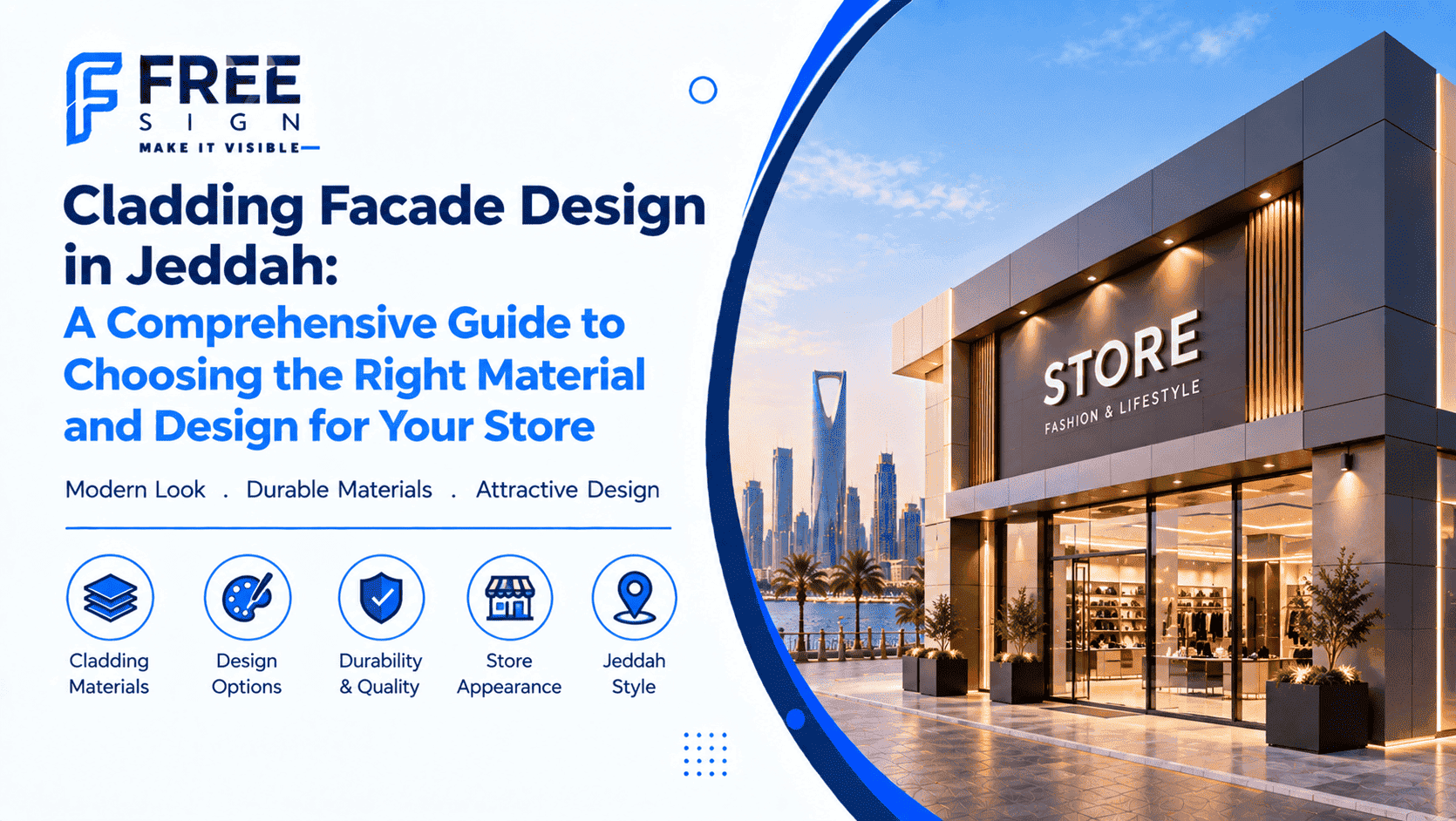
Walk down a commercial street in Jeddah and you will find one store that makes you look at it before you even read its name, while another store offering the same products goes unnoticed. The difference often lies not in the advertising or location, but in a facade that has been designed and installed using materials capable of withstanding coastal humidity and summer sunlight without fading. This is why cladding facade design in Jeddah has become an investment decision that can affect the number of people entering a store and even the value of the property itself. In this guide, we explain the materials, designs, technical steps, and mistakes that can cost store owners money after installation, helping you make an informed choice from the start.
There is no single cladding type that is the best for every project. Instead, there is a type that is best suited to your business, budget, and building location. The practical rule is simple: the closer the facade is to the sea, the greater its exposure to sunlight, and the longer its required service life, the more important it becomes to choose highly resistant materials, even if this increases the initial cost.
What Is Cladding and Why Is It Popular for Store and Building Facades?
Cladding is an external facade system consisting of panels installed over the building’s structural wall using a metal framework. The panels become the visible exterior facade, while the original wall remains protected behind them. This simple concept is the key to its popularity: you do not need to demolish or rebuild the structure. Instead, you can completely transform the appearance of the building within a few days, compared with stone, marble, or paintwork that usually requires more time. Cladding is not limited to aesthetics. The panels protect walls from occasional rain, dust, and salts, and can help reduce heat absorption when combined with suitable insulation. They also make maintenance easier because cleaning panel surfaces is much simpler than cleaning a brick or plastered facade. For this reason, cladding is now widely used for the facades of retail stores, restaurants, cafes, pharmacies, showrooms, service centers, gas stations, and administrative offices, as well as villas and residential and commercial buildings. One aspect that many people overlook is that cladding is a visual identity tool before it is simply a construction material. The selected color, panel layout, and integrated lighting lines all contribute to shaping the customer’s impression of the store before they even enter. When the facade is designed to incorporate your brand colors and make your name visible from a distance, you can reduce part of your advertising budget because the building itself promotes your business around the clock.The Difference Between Cladding and Other Facade Cladding Options
Compared with natural stone, marble, or exterior ceramic, cladding is lightweight and does not add significant loads to the structural frame. This is particularly important for older buildings that were not designed to support heavy facade finishes. Its flexibility also allows for curves, angles, and geometric shapes that can be difficult to achieve with stone. In terms of overall cost, cladding is generally less expensive to install and requires less time, although quality varies significantly from one material to another. Choosing the cheapest option without proper inspection may mean replacing the facade after only two years.Why Is Cladding Facade Design in Jeddah Different From Other Cities?
Jeddah is a coastal city, and this fact alone changes the rules. The air is loaded with humidity and salt spray, summer sunlight is strong and persistent, and dust occurs frequently during certain periods of the year. A facade designed according to the standards of a dry inland city may look excellent on the day of handover and then begin to deteriorate after one or two seasons. The main factors a designer should consider in Jeddah include:- High humidity: It can cause untreated metals to corrode and some low-quality materials to swell. Therefore, galvanized steel or aluminum frameworks and stainless-steel fasteners are preferred.
- Marine salts: They accelerate rusting in screws, hinges, and brackets. The closer the building is to the Corniche or waterfront, the more important it becomes to select materials with higher corrosion resistance.
- Ultraviolet radiation and heat: These can cause colors to fade when weak coatings are used. Panels coated with highly color-stable finishes are therefore a safer option in the long term.
- Thermal expansion: Metal panels expand and contract between day and night. The design must include properly calculated expansion joints to prevent panels from warping or fixing points from cracking.
- Dust-laden winds: They require properly sealed edge details to prevent dust and water from penetrating behind the panels.
Types of Cladding Used for Jeddah Facades
Choosing the material is the first major decision in the project. All other decisions regarding cost, appearance, and lifespan depend on it. The following are the most commonly requested types in the Saudi market, with a practical explanation of each.Aluminum Composite Cladding (ACP)
This is the most widely used option for commercial store facades. The panel consists of two thin layers of aluminum surrounding a polymer core, with common thicknesses ranging from 3 to 4 mm. It is lightweight and easy to cut, bend, and shape. It is also available in hundreds of colors and finishes, including glossy, matte, metallic, mirror, wood-look, and stone-look finishes. It is a practical choice for anyone looking for a modern facade at a reasonable cost with fast installation. The important point here is the type of core. A standard core is combustible and may not be suitable for high-rise buildings or large public gatherings, while a fire-resistant core provides a higher level of safety and is required by the relevant authorities for certain types of buildings. Always ask about the core type before signing a contract.PVDF and Nano Cladding
This type consists of aluminum composite panels coated with a highly color-stable PVDF finish and is sometimes marketed as nano cladding. Its main advantage is resistance to fading, peeling, and UV exposure. It is therefore suitable for facades exposed to direct sunlight throughout the day and projects that require long-term color stability. It costs more than standard coatings, but in Jeddah it is worth considering because repainting or replacing faded panels can be more expensive in the long run.HPL Cladding
HPL panels are made from layers of resin-impregnated fibers compressed under high pressure and temperature, producing a rigid panel with high resistance to scratching, moisture, and impact. They are available in finishes that convincingly imitate natural wood, stone, and concrete. They are widely used for cafe and restaurant facades, high-end stores, and modern residential buildings. Their drawback is that they are heavier and more expensive than ACP and require experienced technicians because cutting and installation demand greater precision.Wood Cladding (WPC and Wood-Look Finishes)
Many people look for wood cladding in Jeddah because the visual warmth of wood attracts customers. However, natural wood cannot withstand humidity and sunlight without continuous maintenance. The practical solution is composite wood (WPC) or HPL and ACP panels with wood finishes. These options provide a similar appearance while offering much better resistance to water, termites, and cracking. This option is very popular for cafe and restaurant facades, outdoor seating areas, and villas.Fiber Cement Panels
These panels are made from fiber-reinforced cement and are known for their resistance to fire, moisture, and insects. They can imitate the appearance of stone, wood, or concrete surfaces. They are suitable for villas, multi-story buildings, and structures requiring high durability and a long service life. However, they are heavier and require a stronger supporting structure and more specialized installation equipment.Fire-Resistant Cladding
Fire-resistant cladding is used in buildings with higher safety requirements, such as high-rise buildings, shopping complexes, hotels, and schools. It relies on a metallic or reinforced metal core that does not contribute to flame spread. If your project is a high-rise building or receives large numbers of visitors, do not treat this option as a luxury. It is often a regulatory requirement.Glass Cladding and Mixed Facades
Many stores in Jeddah combine cladding with glass: a glass facade displays products or the interior atmosphere, surrounded by a cladding frame carrying the store name and brand colors. This combination creates a balance between transparency and solidity and is suitable for jewelry stores, fashion stores, perfume shops, and showrooms. Learn more: How to Install Cladding FacadesQuick Comparison Table of Cladding Types
| Type | Weight | Moisture Resistance | Color Stability | Best Suited For |
| Aluminum Composite ACP | Lightweight | Good | Good to high depending on coating | Retail stores, offices, gas stations |
| PVDF / Nano Aluminum Composite | Lightweight | High | Very high | Facades exposed to direct sunlight, long-term projects |
| HPL | Medium to heavy | High | High | Cafes, restaurants, high-end stores |
| WPC Composite Wood | Medium | High | Good | Outdoor seating areas, cafes, villas |
| Fiber Cement | Heavy | High | Good | Villas and multi-story buildings |
| Fire-resistant | Depends on type | High | Depends on coating | High-rise buildings and large public gatherings |
Professional Cladding Facade Design Steps: From Concept to Handover
Good design is not simply a beautiful image sent to the client and then forgotten. It is a structured process in which every decision affects what comes next. Below are the stages of a successful facade project, from the first meeting to the moment the store opens.Stage One: Site Inspection and Assessment
Before drawing a single line, the facade should be measured on-site rather than relying solely on dimensions written on documents. Widths and heights are measured, while the existing wall is inspected for levelness, moisture, and cracks. The locations of columns, beams, existing air-conditioning openings, electrical points, and lighting are also reviewed. The angle of sunlight on the facade throughout the day should also be observed. A west-facing facade, for example, is exposed to strong afternoon heat and requires different solutions from a north-facing facade. The street itself should also be considered: From what distance can pedestrians see the store? Are trees or neighboring signs blocking part of the view? These details determine the location and size of the main sign and the background color.Stage Two: Understanding the Business Identity and Target Audience
A pharmacy facade is different from a barbecue restaurant facade, just as a men’s salon facade differs from a gift shop facade. A good designer asks: Who is the target customer? What impression should the facade create: professionalism and trust, warmth and comfort, or luxury and distinction? What are the current brand colors? Is there a visual identity guide that must be followed, especially if the store is part of a chain? Answering these questions saves hours of revisions later because the design starts with the business objective rather than personal taste.Stage Three: Initial Concept and 3D Design
At this stage, an initial concept is presented to define the arrangement of masses, panels, glass, signage, and lighting. Ideally, it should be presented as a 3D model showing how the facade will look from the street during both day and night, as lighting can significantly change the perception of color. A good model allows you to see the store from the perspective of someone passing by in a car and from the perspective of pedestrians, helping you identify early whether the store name is easy to read.Stage Four: Selecting Materials, Colors, and Finishes
The concept is turned into specifications at this stage: panel type, thickness, color, and texture, along with the type of supporting structure, fasteners, insulation materials, and silicone. It is preferable to request actual panel samples and view them in daylight, as colors displayed on a screen may differ slightly from reality. These specifications should be recorded in a clear table to prevent discrepancies between what was agreed upon and what is ultimately installed on the facade.Stage Five: Shop Drawings
This is where an attractive design becomes drawings that technicians can understand: the dimensions of each panel, joint locations, corner and edge details, lighting and cable positions, and drainage details. The absence of shop drawings is a common cause of on-site errors because technicians are forced to improvise, resulting in irregular joints or changes in panel dimensions at the corners.Stage Six: Manufacturing, Installation, and Handover
The panels are cut and shaped according to the drawings. The metal framework is then installed and checked for levelness before any panels are fixed. The panels are subsequently installed, joints are sealed, and the lighting and signage are fitted. Finally, the facade undergoes a comprehensive inspection to check the alignment of lines, color consistency, and surface cleanliness before handover. The client is also provided with a summary of cleaning and maintenance guidelines. Read also: Modern Storefront Facade DesignCladding Facade Design Ideas and Styles Based on Business Type
There is no single facade design that suits every business. Below are common styles in Jeddah and the types of businesses each style serves best.Restaurant and Cafe Facades
These businesses rely on the customer’s impression even before they enter, so warm finishes work particularly well. Combining wood-look panels with a matte dark color and warm LED lighting hidden behind the edges creates an attractive facade after sunset, which is peak time for many restaurants in Jeddah. Practical ideas include highlighting the store entrance with a projecting section in a different color so that the entrance is clearly visible, as well as adding an awning or partial shade for outdoor seating if the space allows.Retail and Fashion Store Facades
These businesses are well suited to clean lines, neutral colors, and large glass areas that display products. The facade should function as a frame rather than the main attraction, because the products in the display window should capture attention. ACP panels in matte gray, matte black, or subtle gold, combined with illuminated raised letters, create an elegant and organized appearance without excessive decoration.Pharmacy, Clinic, and Medical Center Facades
The goal here is to create a sense of cleanliness and trust. Light colors, calm green or blue tones, balanced white lighting, and a highly visible sign that can be read from a distance work well. Easy-to-clean surfaces that do not quickly show dust are preferred, while privacy should be considered when the facade includes glass.Gas Station and Service Center Facades
These facades require clear visibility from a distance and quick recognition of the brand identity. Colored panels using the brand’s colors, combined with long lighting lines defining the building’s boundaries, work effectively. Special safety requirements for this type of facility must also be considered when selecting the panel core.Office and Corporate Facades
Professionalism and simplicity are the foundation here. Straight lines, clear colors, and reflective or semi-transparent glass create a corporate image. A single distinctive element, such as a brand-colored strip or a large illuminated logo, can be added to prevent the facade from looking dull.Villa and Residential Building Facades
In residential buildings, durability, privacy, and a calm appearance are usually the priorities. Stone- or wood-look panels and fiber cement work well, combined with aluminum accents around frames and projecting ceilings. Thermal insulation should also be considered, as energy savings during Jeddah’s summer can have a noticeable impact on electricity bills.Most Popular Design Styles
- Modern facade: Straight lines, projecting and recessed sections, neutral colors with one accent color.
- Luxury facade: Metallic or mirror panels, subtle gold or bronze, and precise concealed lighting.
- Industrial facade: Dark colors, rough-looking materials, and focused lighting, suitable for trendy cafes and restaurants.
- Modern classic facade: Frames and soft details with warm colors, suitable for family-oriented stores and villas.
- Minimalist facade: Clean spaces and one clear line for the business name. It is less expensive and offers greater flexibility in the future.
Colors, Lighting, and Signage Within Facade Design
Choosing Colors
Color serves three functions: it expresses the brand identity, creates the contrast needed for the sign to be readable, and determines how much heat the facade absorbs. Light colors reflect more heat but show dust quickly, while dark colors create a luxurious appearance but absorb more heat and reveal scratches and fingerprints more easily. In Jeddah, the practical choice is generally medium to light colors for large surfaces, with dark or stronger colors used for smaller elements and details. Always make sure that the lettering color has clear contrast with the background, because a store name that is difficult to read can weaken the entire investment.Lighting: What Makes the Difference at Night
Most commercial activity in Jeddah takes place after the afternoon, and a facade that looks ordinary during the day can become a major attraction at night with carefully planned lighting. Common techniques include backlighting for raised letters, concealed LED lines in edges and joints, corner spotlights that highlight panel textures, and soft entrance lighting that encourages customers to enter. Outdoor-rated lighting that is resistant to water and dust should be selected. Wiring should also be concealed inside the framework rather than left exposed, as hanging wires can ruin even the most beautiful design.Integrating the Signage with the Cladding
The main sign is the most important element of the facade and should be designed as part of the overall concept rather than added later. Raised letters made of acrylic, stainless steel, or aluminum and mounted onto the cladding surface create a strong three-dimensional presence. Fully illuminated box signs, meanwhile, are suitable for stores that require maximum visibility. It is important to determine the mounting points during the design stage so that the panels do not need to be drilled after installation. Random drilling into a colored panel leaves a permanent mark. Advertising and signage companies that handle design, manufacturing, and installation in one place can help prevent coordination problems between the contractor and signage provider. Read also: How to Design Road Directional SignsTechnical Installation Aspects: What Really Determines the Facade’s Lifespan?
Many people assume that facade quality depends solely on the type of panel. In reality, what lies behind the panel is equally important, and installation mistakes are one of the main causes of premature facade failure.Supporting Structure
Cladding is installed over a metal framework, either made of properly galvanized steel or aluminum sections. The framework must be perfectly level and securely fixed to the wall using fasteners suitable for the wall type. Even a slight tilt in the framework can later appear on the panel surface as waves or irregular joints. In areas close to the sea, stainless-steel fasteners suitable for marine environments are preferred to prevent corrosion.Insulation and Water Infiltration Prevention
A gap should be left behind the panels to allow ventilation and drainage of any moisture. Suitable insulation should also be installed on the wall if the goal is to reduce heat transfer. Joints between panels should be treated with external-grade tape or silicone that is resistant to UV radiation. Low-quality silicone can crack during the summer and allow dust and water to enter. A common mistake is completely sealing all openings, trapping humid air behind the panels and accelerating corrosion.Thermal Expansion and Joints
Metal panels expand with heat and contract with cold. Therefore, the design must include calculated expansion gaps between panels and along the edges. Ignoring these gaps can lead to panel bulging, cracked coatings, or loose fixing points. Regular joints are not merely an aesthetic consideration; they are an essential part of facade engineering.Corner and Edge Details
Corners are typically weak points in facades because water and wind are concentrated there. Special finishing sections and corner profiles are used, while the lower and upper edges are treated with covers that prevent water infiltration. The slope of horizontal surfaces should also be checked to prevent water and dust from accumulating.Quality Inspection Before Handover
Before accepting the facade, inspect the following: surface levelness from a side view, joint alignment, clean panels free of scratches, secure signage and lighting, fully functioning lighting, and color matching with the approved sample. Do not hesitate to request corrections before signing the handover, as making adjustments after acceptance is more difficult and expensive.Municipality and Safety Requirements Before Installing a Cladding Facade in Jeddah
Changing a facade in Saudi Arabia is not purely a personal decision. There are authorities that regulate the appearance, safety, and signage of buildings. The best approach for a business owner is to ask about these requirements before signing a contract rather than after installation, so you do not risk being required to remove or modify part of the work at your own expense.- Signage and facade requirements: Municipal authorities establish regulations governing sign size, location, lighting, and how the business name is displayed. These requirements may vary depending on the neighborhood, street type, and business activity. Always verify the latest applicable requirements at the time of installation, as they may be updated.
- Permits: Modifying a facade or installing a new sign may require a permit or authorization in many cases. Applications are generally submitted through the official channels of the relevant authority. Ask the installation company whether it handles these procedures or whether they are your responsibility.
- Fire safety requirements: The materials permitted for facades depend on the building’s height and intended use. Some buildings are subject to Civil Defense and Saudi Building Code requirements regarding fire resistance. Therefore, do not choose panels based on price alone.
- Structural safety: The framework must withstand wind loads and have sufficient fixing points, particularly on large or elevated facades. A falling panel can cause injuries and legal liability.
- Owners’ approval: If the store is located in a shared building or shopping center, you may need approval from the property owner or owners’ association regarding the design and colors.
How Much Does Cladding Facade Design and Installation Cost in Jeddah? Pricing Factors
The price per square meter of cladding is one of the most frequently asked questions, but the figure you hear during a short phone call often does not reflect the actual final cost. The reason is that the total price consists of many elements, and understanding them protects you from being attracted by a low price that hides missing specifications.Factors That Determine the Price of a Cladding Facade
- Panel type and thickness: The price difference between an economical panel and a high-quality one can be significant. This usually reflects real differences in aluminum thickness, coating type, and core material.
- Facade area: The larger the area, the lower the price per square meter usually becomes because fixed costs are distributed across a larger area.
- Design complexity: Corners, curves, projecting elements, and precise joints require more time and increase panel waste.
- Supporting structure: The type and thickness of the metal, as well as the galvanizing layer, affect both the price and the expected lifespan.
- Insulation and auxiliary details: Thermal or waterproof insulation and customized finishing details increase the cost but also improve quality.
- Lighting and signage: Raised letters, lighting, and illuminated boxes are usually priced separately from the cladding itself.
- Height and access difficulty: High facades require scaffolding or lifting equipment and trained installation teams.
- Removal of the old facade: If an existing facade needs to be removed or the wall behind it needs repairs, this will be an additional cost.
- Permits and procedures: If the company handles these requirements, they may be included in the quotation.
- Execution time and schedule: Urgent projects may cost more, so it is better to plan the work in advance.
How to Compare Quotations Correctly
Do not compare the final price alone. Ask each company for a detailed quotation specifying the panel type and thickness, coating and core type, supporting structure, fastener material, and whether the quotation includes insulation, silicone, lighting, and signage. Also ask about the warranty period and what it covers. When you compare quotations this way, you will often find that the cheapest offer is cheaper because it leaves out an important item or uses lower-quality materials.How to Save Money Without Sacrificing Quality
Smart cost-saving does not mean reducing panel thickness or eliminating insulation. Instead, consider decisions such as choosing a simple design with clean lines instead of complex details, standardizing panel sizes to reduce waste, using premium materials in a small but visually important area such as the entrance while using good economical materials for the rest of the facade, and coordinating the installation schedule to minimize business interruptions during installation. Read also: Best Advertising and Signage Printing Company in JeddahCommon Mistakes in Cladding Facade Design and Installation and How to Avoid Them
Learning from other people’s mistakes is cheaper than paying for your own. These are the most common mistakes found in cladding projects:- Choosing materials based only on price: The result is often a facade that fades or develops bulges after the first summer, with repair costs exceeding the amount initially saved.
- Ignoring shop drawings: Technicians rely on estimates, resulting in uneven joints and poorly aligned corners.
- Failing to allow for expansion joints: The panels can develop a wavy appearance only a few months after installation.
- Using non-rust-resistant fasteners: Brown streaks may appear on the panels, which is a common issue in humid environments.
- Using too many colors: More than three main colors on one facade can distract the eye and weaken the visual identity.
- Poorly visible signage: Small letters or a background color that is too similar to the lettering makes the business name difficult to read from the street.
- Designing the lighting at the final stage: Wires become visible elements, and the facade loses its visual appeal at night.
- Ignoring drainage and ventilation behind the panels: Moisture becomes trapped and metal components can corrode unnoticed.
- Failing to check regulatory requirements: The owner may be forced to stop the work or modify completed installations.
- No clear contract or written warranty: When a defect appears, disputes can begin over who is responsible for what.
Cladding Facade Maintenance and Cleaning to Preserve Its Appearance
Cladding is one of the easiest facade systems to maintain, but it should not be left without care. In a coastal city like Jeddah, dust and salt deposits can accumulate on surfaces, so regular maintenance is recommended.- Regular cleaning: In most cases, clean water, a mild detergent, and a soft cloth or soft brush are sufficient once or twice a year, depending on dust levels and how close the facade is to the sea.
- Avoid abrasive materials and strong solvents: These can damage the coating and leave permanent marks.
- Inspect joints and silicone: Check them at least once a year and repair any cracked areas before water can penetrate.
- Inspect fasteners and lighting: Make sure there is no rust, looseness, or exposed wiring.
- Repair damage quickly: Any scratched or bent panel should be replaced promptly before it affects the overall appearance of the facade.
- Keep spare panels: It is a good idea to keep several panels from the same batch and in the same color, as panel colors may vary slightly between production batches if a replacement is needed later.
How to Choose the Right Company for Cladding Facade Design and Installation
The company you choose will determine up to 80% of the project’s final result. These practical questions can help you distinguish a professional company from one that relies mainly on promises:- Do they provide design, execution, and installation under one responsibility? This reduces disputes between the designer and installer.
- Do they have a genuine portfolio of previous projects? Ask for photos and examples of projects similar to yours, and preferably visit a completed project if possible.
- Do they provide a 3D design before execution? This reduces surprises.
- Are material specifications clearly stated in the quotation? Unclear specifications are a warning sign.
- Do they handle requirements and permits? An experienced company knows what is required and can guide you through the process.
- What warranty do they provide, and what does it cover? Ask for the warranty in writing with a clearly defined duration and terms.
- Do they have specialized technicians and suitable equipment? This is especially important for high-rise facades.
- How do they handle modifications and after-sales service? A good company remains available after the project is handed over.
Practical Tips for Designing a Facade That Attracts Customers and Increases Sales
A successful facade goes beyond appearance to deliver commercial value. Here are some practical tips that can be applied to most businesses:- Make the business name the first thing people see: Large, clear lettering with strong contrast against the background is more important than excessive decoration.
- Reduce the number of elements: A facade built around one clear idea is more effective than one trying to communicate everything at once.
- Design for moving viewers: Most people who see your store will be passing by car, so quick readability from a distance is more important than fine details.
- Highlight the entrance: Use a different color or lighting treatment around the door so visitors can easily identify the entrance.
- Maintain a consistent brand identity: Use the same logo colors and fonts across the facade, interior, and printed materials.
- Think about photography: Many customers photograph storefronts and share them online, so an attractive facade can become free advertising.
- Plan for the future: Choose a design that allows individual panels or signage to be changed without rebuilding the entire facade. This can save money when offers or branding change.
Why Choose Free Sign for Cladding Facade Design and Installation in Jeddah?
At Free Sign, we treat the facade as a complete project, not simply a panel installed on a wall. We begin by understanding your business and target audience and finish with a facade that works for your business every day. Here are the key benefits you receive when working with us:- Design based on your business goals: We ask about your business, target customers, and brand identity before suggesting a design, ensuring the facade supports sales rather than appearance alone.
- 3D visualization before execution: You can see your facade visually and make adjustments before fabrication and installation, reducing surprises and making decisions clearer.
- Materials suitable for Jeddah’s climate: We recommend materials based on your location and the facade’s exposure to sunlight and humidity, and explain the differences clearly, whether you choose ACP, HPL, or another option.
- Clear specifications in the quotation: You know exactly what you are paying for, including panel type, thickness, supporting structure, lighting, and finishing.
- Design, signage, and lighting in one place: We design the cladding, advertising signage, raised letters, and lighting as one coordinated system, so you do not need to coordinate with multiple providers.
- Professional installation and quality control: Our trained technicians focus on proper structural alignment, consistent joints, and clean finishing before handover.
- Commitment to agreed deadlines: We establish a clear schedule and keep you updated on the progress of the work.
- Compliance with regulatory requirements: We discuss signage, safety, and permit requirements with you from the beginning to help prevent project delays.
- Post-handover support: We explain how to clean and maintain your facade and remain available for any concerns after installation.
- Solutions for different budgets: We offer material and design alternatives based on your budget without compromising the essentials that protect the facade and extend its lifespan.