
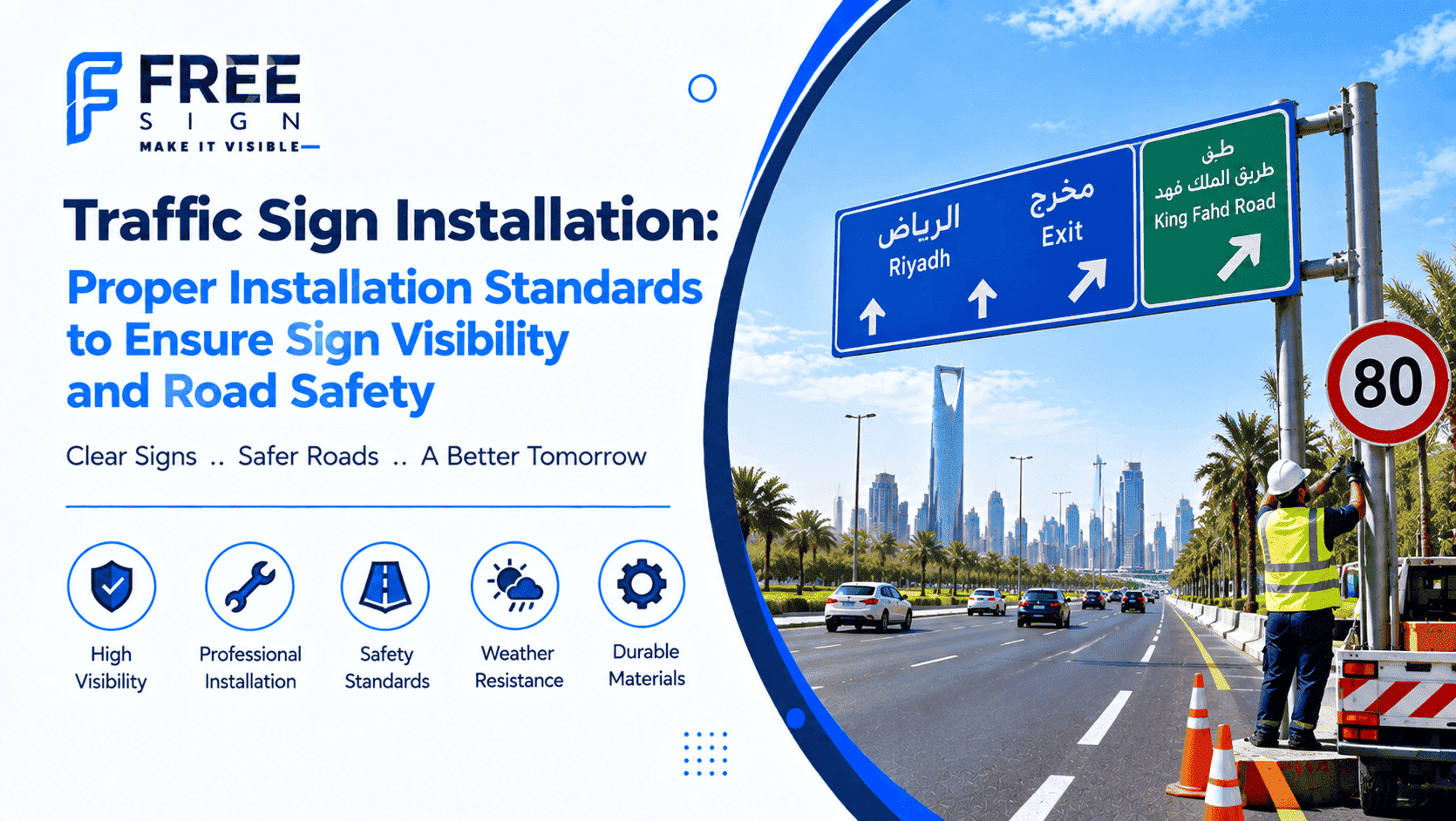
Imagine a driver approaching a busy intersection during rush hour, only to find a faded sign or one mounted at the wrong angle, making it impossible to read until it is too late. This simple scenario highlights the difference between a professionally installed traffic sign and one installed without proper standards. Traffic sign installation is not a decorative process or a formality added to a project at the last minute. It is the first line of defense for protecting lives and regulating traffic on both highways and local roads. In this guide, we take you step by step through the world of traffic sign manufacturing, supply, and installation in Saudi Arabia, from official standards to the technical details that are often overlooked.
What Are Traffic Signs and Why Is Proper Installation a Safety Requirement Rather Than a Luxury?
Traffic signs are approved visual communication tools used to guide drivers and pedestrians, regulate traffic, and warn of potential road hazards. Their role is not limited to providing directions. They also help enforce traffic regulations and reduce accidents caused by confusion or a lack of information while driving. Therefore, traffic sign installation is directly connected to road safety in its broader sense. When a sign is installed at the wrong angle, positioned at an inappropriate height, or manufactured using low-quality materials whose colors quickly fade under sunlight, the message that should reach the driver within seconds can instead become a source of distraction or confusion. Field studies in traffic engineering indicate that a significant proportion of accidents associated with intersections and curves can be linked to the absence of clear directional signage or signs installed in locations that do not provide an adequate line of sight for drivers. For this reason, traffic sign installation in Saudi Arabia is subject to a detailed set of requirements established by the relevant authorities. These requirements cover everything from selecting the appropriate sign type and manufacturing materials to determining the installation location, height, and angle in relation to vehicle movement.The Difference Between a Properly Manufactured Sign and an Improperly Installed One
Many construction, commercial, and industrial projects treat traffic signs as an additional item on the project plan and resort to quick, low-cost solutions that have not undergone proper engineering review. The result is often signs whose colors peel within a few months, poles that bend during the first strong winds, or signs that lose the retroreflective properties that make them visible at night. By contrast, a sign manufactured and installed according to carefully defined standards can remain clear and effective for many years while maintaining its primary function: delivering the right information at the right moment.Types of Traffic Signs Used in Saudi Arabia
Before discussing installation details, it is important to understand the main classifications of traffic signs, as each type has different manufacturing and installation requirements.Regulatory Signs
These are signs that require drivers to follow specific instructions, such as Stop, No Parking, Mandatory Direction, and Speed Limit signs. These signs generally feature standardized geometric shapes, including circles, octagons, and inverted triangles, along with precisely defined colors. Any deviation from the required shape or color may reduce their regulatory effectiveness and legal significance.Warning Signs
Warning signs alert drivers to potential hazards ahead, such as sharp curves, road intersections, roadworks, or pedestrian and animal crossings. These signs are often triangular, with reflective yellow or red elements designed to attract attention from a sufficient distance and give drivers enough time to respond safely.Directional Signs
These signs provide directional information such as road names, distances to cities and destinations, highway exits, and service locations such as fuel stations and hospitals. They are typically designed with blue or green backgrounds depending on the type of road, whether urban or highway, while standardized fonts and lettering sizes help ensure readability from a distance and at high speeds.Informational and Service Signs
These include parking signs, public facility signs, temporary construction project signs, and signs used in commercial and residential developments. Although they do not always fall under the same strict official framework as public traffic signs, professional installation remains important for presenting the facility properly and helping organize traffic within private sites. Read also: Raised Letters for Commercial FacadesThe Meaning of Colors and Shapes in Traffic Signs and Why They Must Not Be Altered
Every color and geometric shape used in traffic signs is not simply an aesthetic choice. It forms part of a standardized visual language that drivers learn from the earliest stages of obtaining a driving license and expect to see consistently on roads.- Red: Commonly used for prohibition and critical warning signs such as Stop and No Entry, as it is highly effective at attracting human visual attention.
- Yellow: Associated with warning signs for upcoming hazards such as curves, intersections, and pedestrian crossings, as it provides strong contrast in conditions such as twilight and dust.
- Blue: Generally used for directional and service signs within cities, including street names and service locations.
- Green: Commonly used for highway signs and intercity distances because it remains readable from long distances and at high vehicle speeds.
- Black and white: Often used for backgrounds or text on regulatory signs such as speed limits, providing clear contrast and easy recognition.
The Difference Between Traffic Sign Installation on Highways, Urban Roads, and Residential Streets
Traffic signs do not all have the same installation requirements. A highway where vehicles may travel at speeds of up to 120 km/h requires completely different standards from a quiet residential street.Highway Traffic Signs
Highway signs require significantly larger dimensions to ensure that drivers can read them from a sufficient distance and respond safely without sudden braking. They are also commonly installed on tall poles or overhead structures (Overhead Signs) where multiple highway lanes or exits require them. High-grade retroreflective sheeting is used to improve nighttime visibility from distances of several hundred meters.Urban and Local Road Traffic Signs
These signs are generally smaller because vehicle speeds are lower. However, they may need to be installed at greater frequency because of the large number of intersections and closely spaced exits. Particular attention is also given to pedestrian crossings, schools, and hospitals, where selecting the appropriate installation location is especially important.Residential Neighborhood and Private Development Signs
Although they are not always subject to the same strict regulations as signs installed on public roads, professional installation remains essential for organizing vehicle movement within residential neighborhoods and private developments. Signs such as No Parking, Speed Hump, and parking-direction signs can help reduce minor accidents caused by congestion at entrances and exits. Read also: Modern Storefront DesignModern Technologies in Traffic Sign Manufacturing and Their Impact on Quality
The traffic sign industry has undergone significant development in recent years with the introduction of digital manufacturing technologies that provide considerably greater precision and durability compared with traditional methods.Laser Cutting
Laser cutting provides highly precise edges for signs, symbols, and lettering, eliminating inconsistencies or roughness that could affect the final appearance or reduce the sign’s durability when exposed to moisture or corrosion.High-Resolution Digital Printing and UV Printing
Modern printing technologies, particularly UV printers, provide vivid, durable colors that resist fading caused by sunlight for longer periods compared with traditional printing. They also allow highly detailed symbols and text to be printed with excellent quality without relying on additional stickers that may peel over time.Digital Design and Pre-Production Simulation
Before moving to actual manufacturing, specialized design software is used to simulate the final appearance of the sign and verify that its dimensions and colors comply with approved standards. This helps reduce errors while saving time and costs before actual production begins.Metal Bending and Treatment
Metal bending machines are used to shape and reinforce sign edges, while metal poles and frames undergo treatment in specialized paint ovens to ensure that the protective coating adheres evenly and permanently. This directly improves the sign’s resistance to rust and corrosion for many years.Criteria for Choosing a Reliable Traffic Sign Installation Company
Choosing the right company to execute a traffic sign installation project is just as important as the quality of the materials themselves. Even the best materials may fail to achieve their intended purpose if they are installed by an inexperienced provider. When evaluating a contractor or sign manufacturer, consider the following:- A complete in-house manufacturing facility: Working with a manufacturer that owns its equipment, including printing machines, laser cutters, metal bending machines, and paint ovens, provides greater quality control and better control over the project schedule compared with companies that rely on multiple subcontractors.
- Experience with similar projects: Reviewing the company’s previous work, particularly projects similar in size and nature to yours, provides a realistic indication of the expected quality level.
- Knowledge of official standards: Make sure the technical team understands the Saudi Road Code and the requirements of the relevant authorities, rather than focusing solely on the manufacturing or commercial aspects.
- Transparent pricing and specifications: The quotation should clearly state the material type and thickness, the type of retroreflective sheeting used, and the warranty period, without vague terms that may result in unexpected issues after installation.
- Fast response and post-installation support: A reliable company should remain available after delivery to handle inquiries, maintenance requests, or subsequent modifications.
Traffic Signs for Temporary Construction Sites
Construction sites and roads undergoing development require a specific type of temporary traffic signage designed to protect workers, pedestrians, and vehicles throughout the construction period. Examples include Road Closed, Traffic Detour, Construction Work Ahead, and temporary speed limit signs within the project area. Unlike permanent signs, these signs require quick-release and easy-to-install mounting systems because they are often moved between different locations or removed as soon as a construction phase is completed. However, they are no less important when it comes to visibility and retroreflectivity. In some situations, they may even require additional lighting or flashing lights due to the temporary and changing nature of hazards within work zones.Other Subcategories of Traffic Signs Commonly Needed by Projects
In addition to the four main classifications, several subcategories are frequently required in practical projects:- Highway distance and exit signs: These inform drivers of the remaining distance to a city or specific exit. They are installed at successive intervals before the actual exit to give drivers sufficient time to change lanes safely.
- Accessible parking signs: These carry the internationally recognized accessibility symbol and are installed in designated parking spaces near entrances to facilitate access. They are required in many modern commercial and government projects.
- Speed hump signs: These alert drivers in advance to an artificial speed hump ahead. They are often accompanied by reflective pavement markings to improve visibility, particularly near residential neighborhoods and schools.
- Variable speed and electronic signs: These are used on some modern highways and smart infrastructure projects to display changing speed limits according to traffic density or weather conditions. Their installation requires specialized technical expertise combining mechanical and electrical work.
- School zone signs: These typically use distinctive colors, such as fluorescent yellow, to attract additional attention during student arrival and departure times due to the sensitivity of these areas and their high pedestrian density.
Approved Standards and Specifications for Traffic Sign Installation in Saudi Arabia
One of the most important characteristics of a successful traffic sign installation project is full compliance with locally approved technical references. In Saudi Arabia, the design, manufacturing, and installation of traffic signs are governed by several regulatory frameworks, most notably the Saudi Road Code issued by the relevant transportation authorities, in addition to requirements established by the Saudi Standards, Metrology and Quality Organization (SASO) regarding material properties and the retroreflective sheeting used. These standards go beyond the sign’s shape and color and also cover:- Dimensions and measurements: Sign dimensions vary depending on the type of road, such as highways, local roads, and residential areas, as well as the designated design speed. Highways generally require larger signs that can be read from greater distances.
- Height above the road surface: The installation height is precisely determined in relation to the sidewalk or road edge to prevent interference with pedestrian movement or conflicts with trucks and high vehicles while maintaining an optimal viewing angle for drivers.
- Horizontal clearance from the road edge: This ensures that the sign itself does not become an obstruction or hazard to passing vehicles, particularly if a vehicle deviates from its lane.
- Retroreflectivity requirements: Retroreflective sheeting that meets specified levels of retroreflectivity must be used to ensure that signs remain visible at night from an adequate distance when illuminated by vehicle headlights.
- Weather resistance: Signs must withstand the Kingdom’s harsh climatic conditions, from high summer temperatures to coastal humidity in western regions, without significant fading or corrosion of the metal substrate.
Spacing Between Successive Traffic Signs
The spacing between signs is just as important as the location of each individual sign. Installing two successive signs too close together can confuse drivers and prevent them from fully processing the first message before encountering the second. Conversely, placing a warning sign too far from the actual hazard may cause drivers to forget the warning or assume they have already passed the relevant location. For this reason, spacing is determined through careful calculations that consider the road’s design speed and the type of information being communicated. The goal is to give drivers sufficient time to read, understand, and respond appropriately without unnecessary pressure or distraction.Coordination with Other Road Elements
Traffic signs are not installed independently of the other elements of road infrastructure. They must be integrated with street lighting poles, concrete and metal barriers, road markings, and traffic signals. Any visual conflict between these elements, such as a tree or lighting pole blocking part of a warning sign, can undermine the overall effectiveness of the traffic management system regardless of the quality of each individual element. For this reason, specialized engineers should be involved during the planning stage to ensure that all road elements are considered together before the final location of each sign is determined.Materials Used to Manufacture High-Quality Traffic Signs
Choosing the right material is the foundation of any successful traffic sign installation project. No matter how precise the installation is, a sign manufactured from poor-quality materials will fail to perform its intended function within a relatively short period.Treated Aluminum
Aluminum is considered a preferred material for traffic sign manufacturing both locally and internationally because it is lightweight compared with steel, naturally resistant to rust and corrosion, and easy to shape and laser-cut into precise, consistent forms. Aluminum sheets used for traffic signs typically range from 2 to 3 mm in thickness, depending on the sign’s size and intended application, providing sufficient rigidity to withstand wind loads without placing excessive weight on the supporting poles.Galvanized Steel
Galvanized steel is used in applications requiring greater rigidity or lower costs, particularly for large signs and directional structures. However, it must have an adequate galvanizing layer to protect it from rust, which can compromise the sign’s appearance and structural durability over the long term.Reflective Sheeting
Reflective sheeting is the element that allows a traffic sign to effectively “communicate” with drivers at night. These materials are classified into several grades according to their level of reflectivity. Diamond Grade sheeting is among the highest-performance options used on highways and in high-risk areas, while Engineer Grade sheeting is used in applications with lower visibility requirements. The appropriate reflective sheeting depends on the type of road, vehicle speeds, and surrounding lighting conditions.Poles and Supports
Poles are just as important as the sign itself because they are responsible for securing it safely while resisting vibration and bending. Poles are typically manufactured from galvanized steel or reinforced aluminum and installed in concrete foundations designed according to the height and surface area of the sign exposed to wind pressure. This helps ensure stability under harsh weather conditions and sandstorms experienced in some parts of Saudi Arabia.Protective Paints and Coatings
Special anti-corrosion and UV-resistant paints are used to protect poles and metal foundations from deterioration. Additional protective coatings may also be applied to the back of the sign to extend its service life in humid coastal environments.Traffic Sign Installation Process Step by Step
A professional traffic sign installation process consists of several sequential stages, and shortcomings at any stage can negatively affect the quality of the final result.Stage One: Site Survey and Assessment
Every successful installation begins with an on-site inspection to assess the road characteristics, traffic volume, expected vehicle speeds, and viewing angles for drivers approaching from different directions. At this stage, the optimal locations for each sign are determined to ensure clear visibility without conflicts with other signs or distracting visual elements such as advertising signs or roadside trees.Stage Two: Engineering and Technical Design
Based on the site survey, a detailed design is prepared for each sign, including its dimensions, standards-compliant colors, font type where text is used, and officially approved symbols. These designs typically undergo technical review to ensure full compliance with the Saudi Road Code before moving to manufacturing.Stage Three: Material Selection and Manufacturing
At this stage, the appropriate aluminum or steel thickness is selected along with the required type of reflective sheeting based on the sign’s location. Actual manufacturing then begins using laser cutting to ensure precise edges and shapes and high-resolution digital printing to maintain color stability under direct sunlight. Poles are also treated with protective coatings or galvanization.Stage Four: On-Site Installation
Installation begins with excavating the foundations and pouring the required concrete to secure the poles in a completely vertical and stable position while maintaining the standard height specified for the type of road. Once the concrete foundation has cured, the sign is attached to the pole at a precise angle designed to provide optimal reflectivity toward approaching vehicles, using rust-resistant connectors and fasteners.Stage Five: Final Inspection and Testing
After installation, the sign undergoes a final inspection covering its stability, visibility during both daytime and nighttime from different distances, and freedom from manufacturing defects or angular deviations. This final stage is what distinguishes a carefully planned professional installation from an improvised installation that may require subsequent adjustments.Stage Six: Handover and Documentation
For government and major projects, the installation process is typically documented through photographs and technical reports submitted to the project owner as evidence that the work complies with the approved specifications. This also facilitates future maintenance and periodic monitoring of the signs’ condition.Traffic Sign Visibility and Nighttime Readability Standards
One of the factors that makes a significant difference in the effectiveness of any traffic sign is its visibility under low-light conditions. Drivers traveling at night or in foggy conditions rely heavily on the sign’s retroreflectivity to identify it from a sufficient distance. The quality of retroreflectivity depends on several interconnected factors, including the type of reflective sheeting used, the cleanliness of the sign’s surface, and its installation angle relative to the path of light from vehicle headlights. For this reason, specialized providers often test signs under conditions that simulate actual nighttime environments before final approval, ensuring that colors such as red, yellow, blue, green, and white maintain clear contrast even when surrounding light levels are low. A well-designed sign also takes into account the distance a driver needs to read and understand its text or symbol and make the appropriate decision. In traffic engineering, this is often referred to as safe reading distance, which generally increases with the design speed of the road.Common Mistakes to Avoid When Installing Traffic Signs
Recurring mistakes in traffic sign installation projects can reduce their effectiveness and sometimes turn them from safety elements into additional hazards. Some of the most common mistakes include:- Ignoring the viewing angle: Installing a sign where it is blocked by trees, lighting poles, or a road curve can completely undermine its effectiveness, regardless of the quality of its manufacturing.
- Using non-compliant materials: Choosing thin panels or low-quality reflective sheeting to reduce costs can quickly lead to fading and peeling within only a few months.
- Poor pole anchoring: Failing to provide concrete foundations with adequate depth and weight can leave signs vulnerable to vibration or bending during strong winds and sandstorms.
- Visual clutter: Installing too many signs within a limited area can confuse drivers instead of helping them. This is a common issue in some commercial projects that attempt to display too much information on one sign or in a single location.
- Neglecting regular maintenance: Treating a sign as a permanent element that requires no follow-up ignores the fact that continuous exposure to sunlight, dust, and rain requires periodic inspection, cleaning, and maintenance to preserve visibility.
- Failing to comply with official colors and shapes: Any deviation from approved colors and shapes, even a minor one, may undermine the sign’s regulatory credibility and confuse drivers who are accustomed to standardized traffic signs throughout the Kingdom.
Saudi Climate Challenges and Their Impact on Material Selection Across Different Regions
The environmental challenges facing traffic signs vary depending on the geographical region of Saudi Arabia. In coastal areas such as Jeddah, Dammam, and Khobar, high humidity and salt content in the air create additional challenges, requiring stronger corrosion protection for metal poles and foundations. In inland areas such as Riyadh and Qassim, sharp temperature fluctuations between day and night, combined with recurring sandstorms, create a greater need for more durable materials and deeper pole foundations to withstand strong winds. In mountainous areas such as Asir and Abha, seasonal rainfall and changing humidity levels add another factor that must be considered when selecting protective coatings and paint systems. Understanding these regional differences is not a secondary consideration. It is a critical factor in ensuring that traffic signs maintain their performance and appearance for many years, regardless of the project’s location within the Kingdom. This makes it important to work with a manufacturer that has practical experience with these regional conditions rather than relying solely on theoretical knowledge.Factors Affecting Traffic Sign Installation Costs
The cost of traffic sign installation can vary significantly from one project to another, depending on several factors that should be considered when requesting a quotation:- Sign size and dimensions: The larger the sign, the greater the amount of materials required and the higher the manufacturing cost.
- Material and reflective sheeting: High-quality reflective sheeting, such as Diamond Grade, costs more than basic options but offers a longer service life and better performance.
- Number of signs required: Large projects requiring dozens or hundreds of signs often receive more competitive pricing compared with individual orders.
- Installation complexity: Sites requiring deep excavation, tall poles, or installation above traffic islands on highways require additional equipment and labor, which affects the overall price.
- Distance and geographic location: Transportation and installation costs vary depending on the site’s distance from the contractor’s location and whether the project is within a major city such as Riyadh, Jeddah, or Dammam or in a more remote area.
Is Investing in Higher-Quality Materials Worth It?
The price difference between a sign made with economical reflective sheeting and one using high-quality reflective sheeting may initially appear significant. However, when the total cost is calculated over the sign’s service life, the picture can be very different. An economical sign that requires complete replacement after one or two years, along with the cost of dismantling and reinstalling it each time, can ultimately cost more than a single high-quality sign that lasts for years with little intervention beyond routine maintenance. For this reason, specialists generally recommend viewing traffic sign installation costs as a long-term investment in safety, rather than as a short-term expense that should be reduced at any cost.The Role of Traffic Signs in Enhancing Road Safety Across the Community
The real impact of traffic sign installation projects is not limited to technical reports or engineering plans. It is reflected in safer daily travel for millions of drivers and pedestrians. Every warning sign installed in the right location can help reduce the risk of traffic incidents, while every clear directional sign can make journeys less stressful and confusing, particularly for visitors and drivers unfamiliar with the area. Traffic signs also play a key role in supporting the efforts of relevant authorities to improve road safety by establishing a consistent visual language across roads and reducing drivers’ reliance on personal judgment when interpreting traffic situations. In areas near schools, hospitals, and busy commercial districts, traffic signs become an essential line of protection for more vulnerable road users, particularly children and older adults. From this perspective, investing in professional traffic sign installation is not solely a technical responsibility for contractors and manufacturers. It is a shared community responsibility whose positive impact extends to everyone.The Importance of Regular Traffic Sign Maintenance After Installation
Many project managers assume that traffic sign installation is complete as soon as the sign is secured in place. In reality, maintaining its effectiveness requires continuous monitoring. Dust accumulating on the sign’s surface can reduce retroreflective performance, prolonged exposure to ultraviolet radiation can gradually fade its colors, and corrosion on poles or loose fasteners can create an actual hazard for pedestrians and vehicles. This makes it important to establish a regular maintenance program that includes:- Regularly cleaning sign surfaces to remove accumulated dust and dirt.
- Inspecting poles and concrete foundations to ensure they remain stable and free from leaning or excessive vibration.
- Periodically evaluating retroreflectivity, particularly on highways with heavy nighttime traffic.
- Replacing signs showing signs of peeling, fading, or corrosion before they lose their warning function.
- Updating directional sign content whenever changes occur in road layouts or location names.
Establishing a Clear Maintenance Schedule
A scheduled maintenance program is recommended instead of relying on random inspections. Regular visits should include a comprehensive visual inspection of every sign, photographic documentation to compare its condition with previous visits, and prioritization of maintenance or replacement based on the level of risk associated with each sign’s location. For example, signs installed at high-traffic intersections or near schools should receive higher inspection priority than directional signs on quiet internal roads because the potential impact of a malfunction is considerably greater.Smart Traffic Signs and the Future of the Industry in Saudi Arabia
With the rapid development of smart-city projects and digital transformation in the transportation sector under Saudi Arabia’s ambitious Vision, new traffic sign applications are emerging that go beyond the traditional fixed sign. Key developments include:- Solar-powered illuminated signs: These signs use small solar panels to power internal or perimeter lighting at night, improving visibility in areas with insufficient street lighting without requiring complex electrical connections.
- Electronic display signs: Modern highways can use electronic signs to display changing information such as congestion conditions, weather warnings, or variable speed limits based on current conditions.
- Sensing and data integration: Some advanced projects are beginning to integrate traffic signs with sensor systems that transmit traffic data to control centers, paving the way for smarter transportation networks in the near future.
Sustainability and Eco-Friendly Materials in Traffic Sign Manufacturing
Environmental considerations have become increasingly important across the industrial and construction sectors, and traffic signs are no exception. This focus is reflected in several practices that are becoming more common among specialized manufacturers:- Aluminum recycling: Aluminum is one of the most recyclable metals and can be recycled without losing its essential properties, making it a more sustainable option than materials that often end up in landfills after their service life.
- Extending the sign’s service life: Every sign that lasts longer because of high-quality manufacturing reduces long-term resource and energy consumption compared with low-quality signs that require frequent replacement.
- Low-emission paints and coatings: Some manufacturers are moving toward paints and treatment materials that are less harmful to the environment and workers without compromising protection against rust and corrosion.
Practical Steps to Start Your Traffic Sign Installation Project with Free Sign
After reviewing these technical and regulatory considerations, you may be wondering about the practical steps between planning and actually implementing your project. The process is simpler than it may seem when working with a specialized provider that manages the details on your behalf:- Initial consultation: Share your project idea and basic requirements by phone, email, or the contact form available on the website.
- Site inspection and needs assessment: Conduct a site visit or review the available plans to determine the required number of signs, their locations, and appropriate dimensions.
- Quotation and preliminary design: Receive a detailed quotation covering materials, specifications, and the expected implementation timeline.
- Manufacturing and execution: Begin the manufacturing process according to the agreed schedule, with the option to monitor the order’s progress periodically.
- Installation and final handover: Complete the actual on-site installation, conduct a final inspection, and hand over the project according to the agreed specifications.
How to Measure the Success of a Traffic Sign Installation Project After Handover
How can you determine whether a traffic sign installation project completed by a specialized provider was genuinely successful rather than simply a basic installation? Several practical indicators can be used for evaluation:- Clear readability from a safe distance: Stand at a distance corresponding to the road’s safe reading distance and verify that the sign’s text or symbol can be understood clearly without requiring excessive proximity.
- Sign stability under pressure: Check that the sign does not vibrate or lean when exposed to moderate winds. This provides a direct indication of the quality of the concrete foundation and pole anchoring.
- Nighttime performance: It is preferable to evaluate the sign at night using ordinary vehicle headlights to ensure that its retroreflectivity provides the required visibility from an adequate distance.
- Compliance with color and dimensional standards: Compare the installed sign with the specifications agreed upon in the contract or quotation and ensure there are no deviations in colors or dimensions.
- Finishing quality and details: Inspect the sign edges, mounting points, and metal connections. Clean finishing without scratches or gaps reflects the level of workmanship during installation.